Today, Wuxi Rihuan Sensing Technology Co., Ltd.will introduce to you which production stations in automotive manufacturing cannot do without sensors? - A comprehensive analysis of the four major processes: stamping, welding, painting, and final assembly.
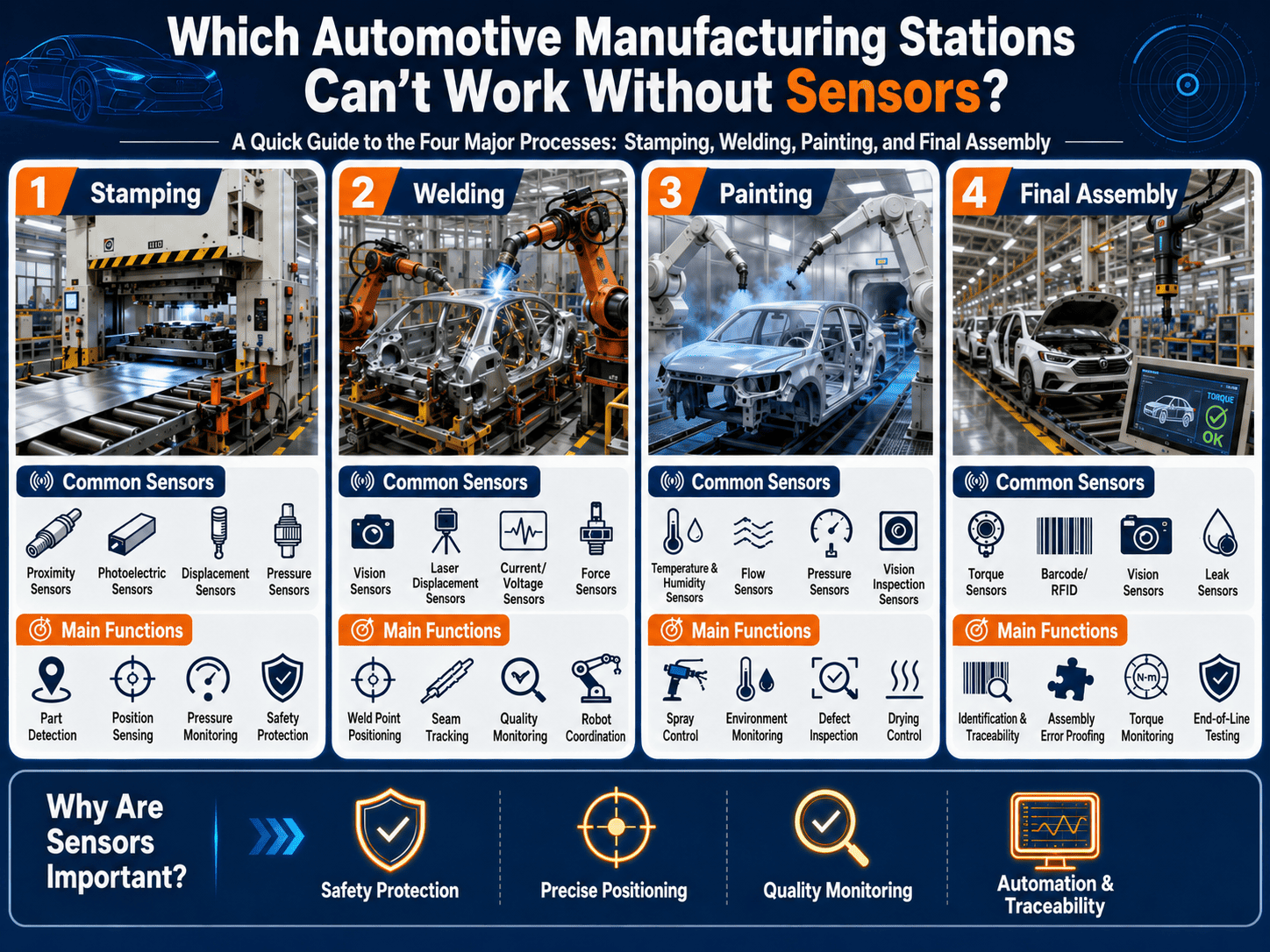
Automotive manufacturing is an extremely complex system project, typically divided into four processes: stamping, welding, painting, and final assembly. Sensors, as the "sensing organs" of the production line, are deeply embedded in each process and undertake key tasks such as position detection, status confirmation, quality monitoring, and safety protection. The following will analyze the typical applications of sensors in the four major processes one by one.
1. Stamping Workshop: From "Is There Material?" to "Is the Position Correct?"
Stamping is the first process in vehicle manufacturing, where steel plates are pressed into body parts such as doors and engine covers. The stamping line is fast and has high impact. Sensors mainly solve two problems: whether the workpiece is in place and whether the position is accurate.
1.1 Material Detection - Confirming "Is There"
The first step in stamping is to confirm whether the sheet material has entered the mold. Sensors are installed in the conveyor line or the gap between belts to determine whether the stamping part has arrived and passed, providing signals for the next material retrieval, transfer, or sorting. Inductive proximity switches are the main force in this process - when the metal sheet approaches, the switch gives a signal to confirm "the material is there".
1.2 Position Detection - Confirming "Is It Correct?"
After the sheet material enters the mold, it must stop at the precise position to be stamped. If there is a position deviation, it could result in the scrapping of the stamped part or even damage to the mold. Inductive proximity switches with RFID tool identification systems can verify the correct positioning of the metal sheet in the press. The typical application is the detection of the position of the guide hole: using an inductive proximity sensor to detect the position of the guide hole, if any deviation is found, the system can stop the press machine from continuing the downward stroke before it is too late, protecting the mold and stamped parts.
1.3 Special Detection Requirements
Ultrasonic Sensor (UMF Series): Monitoring the sag of the strip to prevent the sheet from loosening or over-tightening during feeding.
Laser Distance Sensor (PNBC Series): Achieving precise positioning of the workpiece in high-temperature environments.
High-speed Stamping Scenarios: The stamping frequency is high and the cycle is fast. Ordinary sensors cannot respond quickly enough. Products such as FF fiber optic sensors (with adjustable response time starting from 100 μs), FC-SPY slot-type photoelectric, and FSCH high-speed proximity switches have response times as fast as 0.1 ms, with 10,000 detections per second, ensuring stable counting and zero-delay confirmation for high-frequency stamping.
2. Welding Workshop: Anti-splashing and anti-interference are key words
The welding workshop (white body assembly) is where sensors are applied in "harsh environments" - welding slag splashing, strong electromagnetic fields, and high temperatures coexist. Here, sensors need to detect whether the welding gun is in place and whether the workpiece is correctly placed in the fixture.
2.1 Weld Gun Position Detection
The welding gun of the welding robot must precisely reach the welding position to perform welding. Proximity switches are installed inside the welding gun or on the fixture to detect the distance between the end of the welding gun and the workpiece. The objects that proximity switches can detect must be metal conductors - the welding gun and the vehicle body are both metal, which is a perfect match.
2.2 Workpiece Position Detection
Vehicle components must be fixed in the fixture before welding. Sensors check whether the parts are in the correct position in the welding fixture. In the positioning detection at the welding station, there may be both iron and aluminum components. Ordinary proximity switches detect the distance between iron and aluminum differently, so full-metal detection proximity switches must be selected to achieve the same stable detection for both iron and aluminum.
2.3 Anti-Welding Environment Design
The sensors in the welding workshop face special challenges:
Welding Slag Splashing: Sensors use a sturdy 316L stainless steel casing and are coated with a lens to be able to withstand welding slag or sparks; Inductive proximity switches with Teflon coating can effectively prevent welding slag from adhering.
Strong electromagnetic interference: During the welding process, a strong magnetic field is generated, and ordinary sensors will experience erratic signal jumps. The anti-magnetic and anti-welding type proximity switch has a special coil structure, which can resist the magnetic field interference generated during the welding process.
4. Visual Inspection
2D/3D profile sensors (such as MLSL123) are used to achieve micron-level gap control for the best-fit assembly of the body panel - whether the gaps between the various components of the body panel are uniform and within the tolerance range directly determines the airtightness and appearance quality of the entire vehicle.
III. Painting Workshop: Triple Challenges of High Temperature, Corrosion, and High Reflectivity
The painting workshop paints the body panels to the final color and undergoes high-temperature baking for curing. The environment here is extremely harsh - the oven temperature is high, the coating is corrosive, and the surface of the body panel is highly reflective.
1. Position Detection of Loading Equipment in the Oven
After the body panel enters the oven, it needs to be precisely transported in the high-temperature environment. Ordinary sensors cannot work properly in the oven. High-temperature proximity switches (such as the INTT series) can operate stably in a maximum temperature of 250°C, detecting the position of the oven loading equipment.
2. Positioning and Alignment of the Body Panel
On the painting line, the body panel needs to precisely stop at each spraying, drying, and cooling station. Reflective beam or reflective plate type photoelectric sensors are widely used in vehicle positioning, providing a high switching frequency of 500Hz to detect the rapidly moving body panel. The photoelectric sensor operates without being affected by the surface or color of the object being measured and the surrounding lighting - this is particularly important for body panels with varying colors after painting.
For low-reflectivity painted body panels (black, blue, etc.), sensors with light spot adjustment technology and anti-interference functions need to be selected to achieve stable and reliable detection.
3. Monitoring of Paint Liquid Level
The paint tanks in the spraying workshop need to monitor the liquid level in real time to ensure continuous and stable spraying operations. High-temperature level capacitive sensors can sense the liquid level change of non-conductive liquids (paint) in real time and automatically trigger replenishment.
4. Color Recognition
In the paint workshop's topcoat process, it is necessary to automatically recognize the body panel color to prevent incorrectly colored body panels from leaving the workshop. White light point photoelectric sensors collect the color signal of the body panel and transmit it to the PLC to achieve automatic recognition of the body panel color.
IV. Assembly Workshop: Visual Error Prevention is the Main Character
Assembly is the last link of the four processes, assembling thousands of components into a vehicle. Here, the variety of sensors is the most abundant, and visual sensors are the absolute protagonist - used for assembly error prevention, quality inspection, and positioning guidance.
1. Assembly Error Prevention
The assembly line has a wide variety of components and complex assembly processes, with errors in assembly being the main quality risk. Visual recognition technology takes photos and compares them at key assembly points to determine whether the parts are installed correctly and whether the model is correct. For example, battery assembly error prevention - after the initial sorting on the shelf is scanned, the fusion model matching visual technology is used for a secondary check to achieve "zero assembly errors".
2. Positioning and Detection of Components
Dashboard installation: 2D vision sensor with high-resolution imaging system captures the characteristic points (installation holes, edge contours) of the dashboard for real-time positioning accuracy of ±0.3mm.
Door, lamp gap measurement: Integrated UV light source contour sensor measures the micrometer-level accuracy of the gap surface difference of the body panel, completing the automatic measurement under continuous movement on the assembly line.
Door interior parts quality inspection: Visual system inspects components such as window switches and different colors of handrails.
3. Guiding for Manual Material Picking
At the material picking workstation on the assembly line, Pick-to-Light light curtain indicates the correct picking point through LED signal lights, reducing error rates and improving the efficiency of manual material picking.
4. Position and State Detection
Vehicle detection on the roller conveyor: Reflective sensors are installed between two rollers below the conveyor plane to detect whether the vehicle is in place.
Engine hood/door opening/closing detection: Measures the light curtain to determine if the vehicle door has been closed, preventing collisions in subsequent processes.
Seat installation confirmation: The flight time laser sensor is aligned within the sunroof to confirm whether the car seats have been correctly installed in place.
Summary
From the proximity switches in the stamping workshop to confirm whether there is material, to the anti-dust sensors in the welding workshop to ensure that the welding gun is in place, to the high-temperature switches in the painting workshop that work stably in the drying room, and finally to the visual sensors in the final assembly workshop to achieve "zero misassembly" - sensors run through every process of automobile manufacturing. The requirements for sensors vary greatly in the four processes: stamping needs to respond quickly, welding needs to be resistant to interference, painting needs to be able to withstand high temperatures, and final assembly needs to be able to detect accurately.
Choosing the right sensor makes the production line run steadily and quickly.
Rihuan Sensing provides sensor products covering all processes of automobile manufacturing - inductive proximity switches, photoelectric sensors , safety light curtains, laser displacement sensors and visual detection components, which are suitable for the strict working conditions of each link in stamping, welding, painting and final assembly. Welcome to follow Jiran Sensing and get professional sensor solutions for the automotive industry.