Today, Wuxi Rihuan Sensing Technology Co., Ltd. will introduce to you how to select the resolution of the measurement light curtain? - The relationship between the object size accuracy and the light beam spacing.
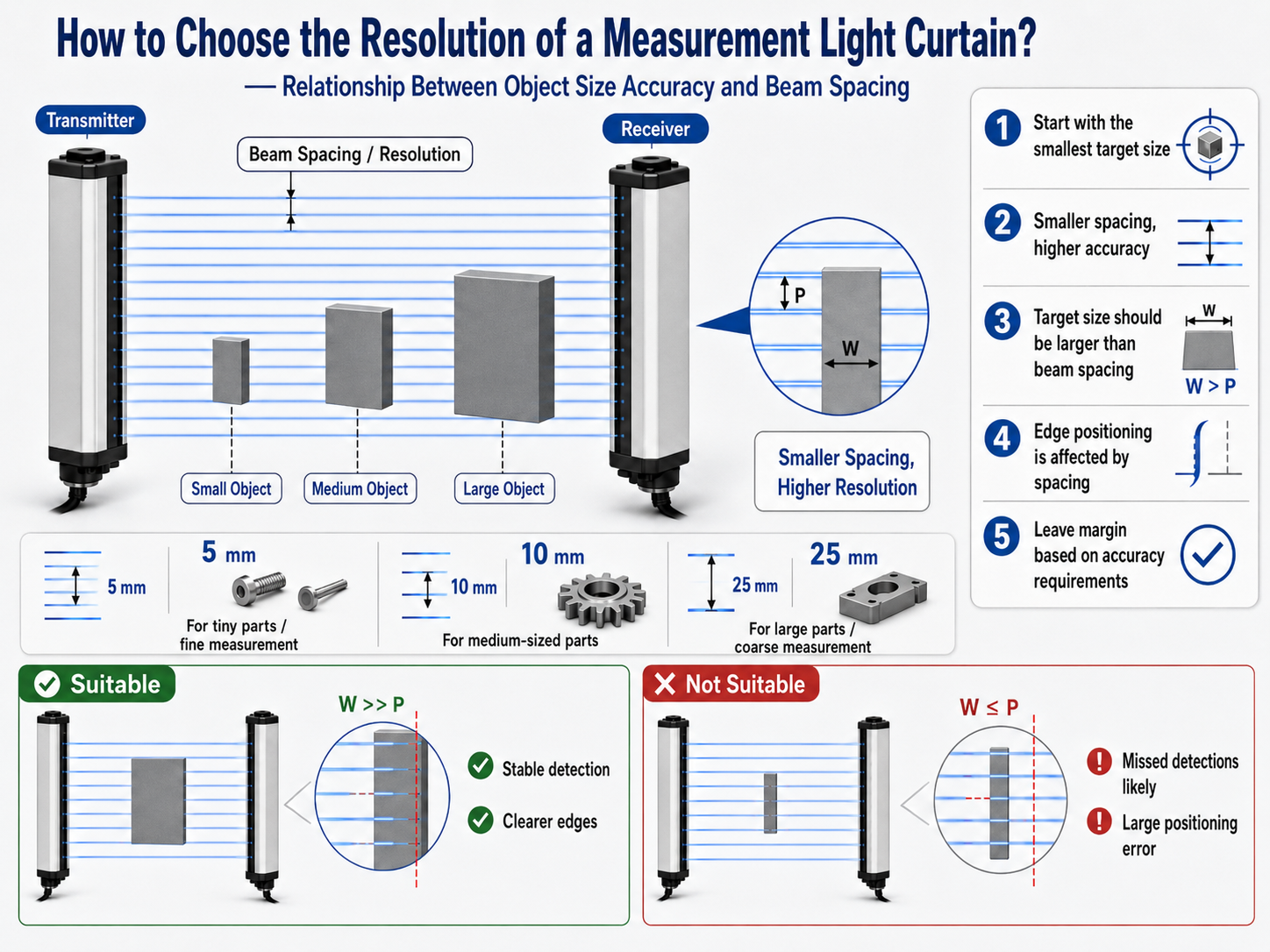
The biggest difference between a measurement light curtain (or measurement grating) and a regular safety light curtain lies in that: the safety light curtain outputs a "present/absent" switch signal, while the measurement light curtain outputs specific size values - how wide, how high, and how much the object is in diameter. Therefore, the selection of resolution directly determines whether the measurement result can be used.
1. What determines the resolution?
The resolution of the measurement light curtain is essentially determined by the light beam spacing (light axis spacing). The light beam spacing refers to the center distance between two adjacent infrared beams. For the light curtain to detect an object, it needs to block at least one beam.
Light beam spacing Minimum detectable object Typical measurement error
1mm ≥1mm ±1~2mm
5mm ≥5mm ±5~10mm
10mm ≥10mm ±10~20mm
The smaller the beam spacing, the higher the beam density - at a 10mm spacing, there are 100 beams per meter, and at a 5mm spacing, there are 200 beams per meter. The denser the beams, the clearer the outline of the object will be and the higher the measurement accuracy will be.
Currently, the beam spacings for measuring light curtains on the market range from 1.25mm, 2.5mm, 5mm, 10mm, 20mm, 40mm, etc. Some high-end models even support custom spacings that are smaller.
II. Resolution does not equal the final accuracy, but it determines the upper limit of accuracy
Many users have a misunderstanding: they think that the resolution is how much the measurement accuracy is. In reality, the accuracy is usually ≥ the resolution value.
For example:
A light curtain with a beam spacing of 2.5mm typically has a measurement accuracy of ±2.5mm.
A light curtain with a beam spacing of 5mm usually has a measurement accuracy of ±5 to ±10mm.
Some high-end models can achieve an edge resolution of 2.5mm through edge detection algorithms - that is, although the beam spacing is 5mm, it can identify edge position changes of 2.5mm.
Resolution determines "how fine it can measure", while accuracy determines "how accurate the measurement is". They are related but not equivalent. When choosing, both resolution and accuracy should be considered.
III. How to choose in different scenarios?
High-precision scenarios (within ±1mm)
Automobile component inspection, electronic product quality inspection, semiconductor wafer thickness deviation, lithium battery electrode edge detection, etc. These scenarios require the use of high-resolution light curtains with a beam spacing of 1mm or 2.5mm. The higher the resolution, the higher the detection accuracy, but the greater the number of beams means increased equipment power consumption and data processing volume.
Conventional industrial inspection (±5mm to ±10mm)
Length measurement of mobile phone body frames, plastic part hole detection, beverage bottle height monitoring, courier package volume measurement, etc. These scenarios can be met with a beam spacing of 5mm or 10mm. For example, in the courier industry: small courier packages require a 2.5mm resolution to identify thin and small packages, while ordinary e-commerce packages with 10mm resolution are sufficient.
Quick measurement scenarios (above ±10mm)
Classification of logistics package approximate sizes, width detection of plates, rough measurement of large workpieces, etc. A beam spacing of 20mm or 40mm can be selected, with lower cost and stronger anti-interference ability.
IV. Core selection principles
The resolution should be ≤ 1/3 to 1/5 of the tolerance requirement of the measured object.
This is the common "tool accuracy rule" in the measurement field - the accuracy of the measuring tool should be at least 3 to 5 times the tolerance of the measured size. For example:
If the width tolerance of the measured workpiece is ±3mm (total tolerance 6mm), then the accuracy of the measurement light curtain should be ≤ 2mm. Converted to beam spacing, it should be selected as 2.5mm or smaller.
If the tolerance requirement is only ±10mm (total tolerance 20mm), then a light curtain with a beam spacing of 10mm can meet the requirements.
The smaller the light axis spacing, the higher the installation accuracy requirements - slight inclination may lead to incorrect beam blocking judgment. At the same time, a smaller spacing means a greater number of beams, which also increases equipment power consumption and data processing volume. When choosing, a balance should be made between accuracy and cost.
V. Common selection mistakes
Using safety light curtains instead of measurement light curtains: Safety light curtains only output "on/off" signals and do not have the function of outputting size data, so they cannot be mixed.
Only focusing on resolution without considering accuracy: Higher resolution does not mean higher measurement accuracy. Refer to the accuracy indicators in the product specification sheet.
Ignoring response time: High-resolution measurement light curtains can provide higher detection accuracy, but they may also affect response speed. High-speed assembly lines need to pay attention to both resolution and response time parameters at the same time.
Selection summary
Scene type Recommended beam spacing Typical accuracy Applicable industries
High-precision measurement 1 to 2.5mm ±1 to 2.5mm Electronics, semiconductors, lithium batteries
Conventional industrial inspection 5 to 10mm ±5 to 10mm Automobile components, logistics, packaging
Quick measurement/large component inspection 20 to 40mm ±20 to 40mm Large workpieces, plate detection
Remember one sentence when choosing: The lower limit of accuracy requirements determines the resolution, and the lower limit of tolerance requirements determines the accuracy.
Rihuan Sensing provides a full range of measurement light curtain products, with beam spacings covering 5mm, 10mm, 20mm, 40mm and other specifications, supporting various data output methods such as RS485 and analog quantity. The products can be widely used in logistics volume measurement, tire size detection, component quality inspection, etc. Welcome to follow us at Dayuan Sensing to obtain professional guidance on selecting measurement light curtains and technical support.