Today, Wuxi Rihuan Sensor Technology Co., Ltd. will introduce to us the "blind zone" of safety grating. Do you know about it? The upper and lower ends actually cannot be detected.
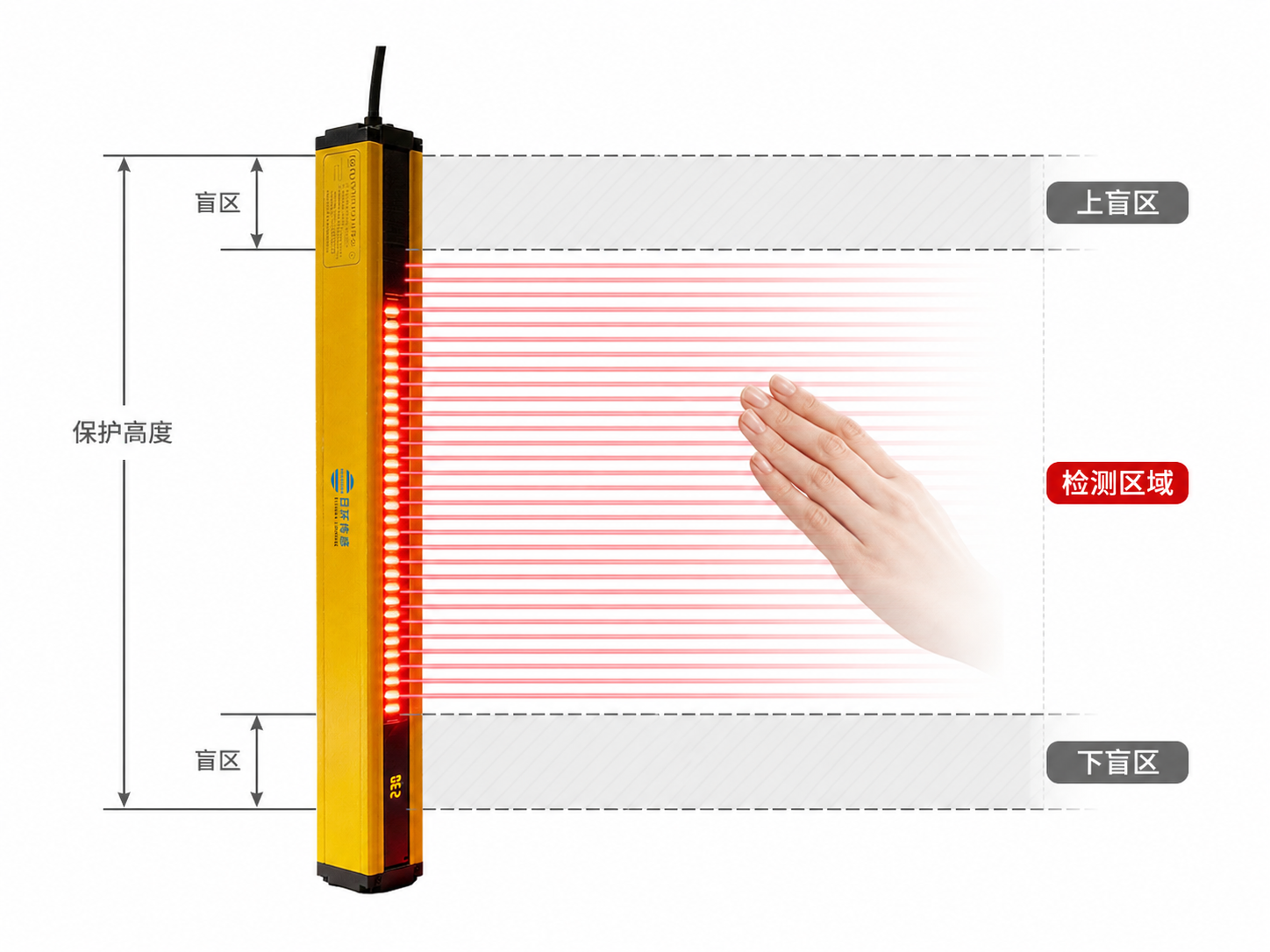
The safety interlock forms an invisible protective barrier by using an infrared beam array between the transmitter and the receiver. Many users believe that the entire area covered by the light curtain can effectively detect, but this is not the case - there are sections at both the top and bottom of the interlock that are undetectable. If the dangerous source happens to be within the blind zone, the interlock becomes ineffective, and the operator may come into direct contact with the dangerous moving parts without triggering the stop mechanism.
1. What is the blind zone of a grating?
The blind zone refers to the area where the safety grating fails to effectively detect the entry of an object. It is located above the uppermost beam of the light curtain and below the lowermost beam.
The effective detection range of the grating is determined by the vertical distance between the topmost beam and the bottommost beam. This range is called the protection height. Beyond this protection height and within the upper and lower ends inside the physical casing of the grating, since there is no beam coverage, any object entering will not be detected.
II. How do blind areas form?
The existence of blind areas is not a design flaw; rather, it is determined by the structure of the grating.
The transmitter and receiver of the safety grating contain circuit boards, optical lenses and casings. The uppermost and lowest beams cannot be arranged to the very edges of the casing - the lenses require certain installation space, and the casing itself also has a thickness. Therefore, there must be a physical gap without beam coverage between the edge of the casing and the first beam.
This gap is the blind zone. The size of the blind zone varies depending on the brand and model of the grating, typically ranging from a few millimeters to several tens of millimeters. When choosing the model, users should consult the product manual to determine the exact size of the blind zone.
III. Safety Risks in Blind Zones: Hazardous Sources Are Hidden in the Blind Areas
The existence of blind zones brings about a safety hazard that is often overlooked: If the hazardous moving parts of the equipment are precisely within the height range of the photogate's blind zone, the operator's arm or tool can extend into the blind zone without being detected.
For example:
The opening height of the dangerous area of a stamping machine is 400mm. A photoelectric sensor with a protection height of 400mm was selected. However, there are 15mm blind zones above and below the sensor. The actual effective protection height is only 370mm, with 15mm gaps on both the top and bottom - a person's finger or a small tool can pass through this gap without triggering the stop mechanism.
After the photoelectric sensor was installed at the entrance of the conveyor belt, the bottom blind area was exactly level with the conveyor belt surface. When the operator bent over and reached down from below to pick up an object, their hand passed through the blind area, but the photoelectric sensor did not respond at all.
The risks within the blind zone are often overlooked by users because the indicator lights of the grating may appear to be functioning normally - no one has entered the effective detection area, and thus no alarm will be triggered. But the danger actually lies beneath the illusion of "no one entering".
IV. How to Deal with Blind Zones?
First, check the blind zone parameters during selection. The product manual of safety photoelectric sensors usually indicates the specific dimensions of the blind zone (or "inoperative detection area"). During the selection process, the protection height should be greater than the actual opening height of the hazardous area, and a margin should be reserved for the upper and lower blind zones. For example, if the opening height of the hazardous area is 400mm and the upper and lower blind zones of the sensor are each 15mm, then at least a photoelectric sensor with a protection height of ≥ 430mm should be selected.
Second, adjust the position during installation. Align the upper and lower blind zones of the grating to areas where no one can enter - for example, the upper blind zone should be aligned with the fixed structural components of the equipment, and the lower blind zone should be aligned with the ground or the equipment base. Ensure that any area that could potentially extend into a human body part is covered by the beam.
Thirdly, enhance auxiliary mechanical protection. If the size of the hazardous area does not perfectly match the height of the photoelectric protection, fixed protective barriers or fences can be installed at the blind zone locations to physically prevent people from entering the blind zone.
Fourth, for special hazardous sources, consider using multiple grating combinations or safety laser scanners. If the shape of the hazardous area is irregular, or the coverage area exceeds the capacity of a single grating, two sets of gratings can be combined for coverage, or a safety laser scanner can be selected to achieve more flexible area protection.
V. Summary
Focus Recommendation
Blind zone location Outside the uppermost and lowest beams of the grating
Blind zone size Refer to the specific product manual; it varies for different models
Selection principle Protection height > Hazardous area opening height + Up and down blind zone
Installation principle Align the blind zone with the area that is impossible to enter
Supplementary measures Install mechanical protective baffles or multiple grating combinations
The blind zone of a safety grating is not a negligible detail - it is a real security loophole. When selecting, only considering the protection height and ignoring the blind zone may lead to a dangerous situation where "thinking you have protection, but actually leaving a door open".
The safety grating products of Rihuan Sensing clearly indicate the upper and lower blind zone dimensions in the manual, and offer various protection height specifications to help users precisely match the on-site requirements. Welcome to follow Rihuan Sensing to obtain professional selection guidance and safety protection solutions.