Today, Wuxi Rihuan Sensing Technology Co., Ltd.will introduce to us how to determine the installation height of safety grilles and how large the protected area should be.
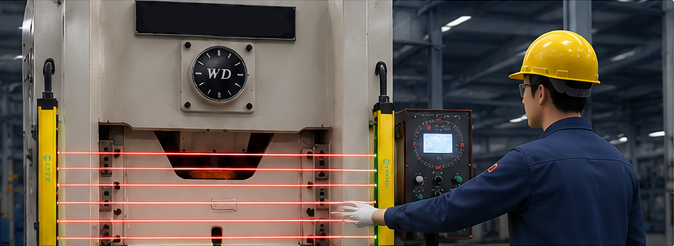
The safety barrier has been installed. Does it mean it's correct if the indicator light is on? Not necessarily. The setting of the installation height directly determines whether the barrier can truly provide protection. If it is installed too low, people may climb over from above; if it is installed too high, someone might crawl in from the bottom without being detected; if the installation distance is insufficient, the equipment may not stop when people extend their arms into it. Based on the international standard EN ISO 13855, the following outlines the methods for determining the installation height and the protected area.
1. First, calculate the safety distance: S = K × T + C
The safety distance refers to the minimum allowable distance between the farthest end of the light curtain of the sensor and the hazardous source. If this distance is not met, installing the sensor at any height is useless. The calculation formula is: S = K × T + C
S: Minimum safety distance (mm);
K: The speed at which the human body or limb approaches (mm/s);
T: Total downtime (s), including the time for the grating response and the time required for the equipment to stop;
C: Additional distance (mm), related to the resolution of the grating and the installation method.
II. How to Choose the K Value? Refer to the Safety Distance Calculation Results
The value of K is not fixed. According to the international standard EN ISO 13855: If the S value calculated based on K = 2000mm/s is less than or equal to 500mm, then this K value can be directly used; if the S value calculated based on K = 2000mm/s is greater than 500mm, then the K value should be changed to 1600mm/s and the calculation should be redone. The underlying logic is: when the distance is relatively far, there is an acceleration process for the human body to move from a static state into the dangerous area. 1600mm/s is equivalent to the normal walking speed of a person, while 2000mm/s is closer to the operating speed of the arm.
III. How to determine the C value? By resolution
The additional distance C is directly related to the resolution of the grating:
Resolution d ≤ 40mm: C = 8 × (d - 14) mm. For example, when d = 25mm, C = 88mm.
Resolution 40mm < d ≤ 70mm: C = 850mm;
Resolution d > 70mm: C = 1200mm.
4. When the sensor is installed horizontally
(the light curtain is parallel to the ground and shines upwards, used to prevent people from entering the dangerous area from above), the safety distance formula becomes: S = 1600mm/s × T + (1200mm - 0.4H)
Here, H represents the height of the light curtain from the ground. According to international standards, H must not exceed 1000mm. It is particularly important to note that when H is greater than 300mm, there is a risk that personnel could pass through from beneath the light curtain. This must be taken into account in the risk assessment; if it is unacceptable, additional protective measures must be implemented.
This is the condition that is most easily overlooked in the installation height setting, but it precisely determines whether the photoelectric sensor has any "dead spots".
Prevent bottom entry: The height from the bottommost beam of the grating to the ground must be ≤ 300mm. If this limit is exceeded, someone can lie down or bend over and crawl into the dangerous area without being detected, and the grating would be ineffective.
Prevent top-over: The height from the highest beam of the grating to the ground must be ≥ 900mm. If this value is lower, someone can simply lift their leg and jump over the barrier to enter the dangerous area.
Some of the standards also provide typical reference heights for multi-beam gratings: for 4-beam gratings, the recommended heights are 300mm, 600mm, 900mm, and 1200mm; for 3-beam gratings, the recommended heights are 300mm, 700mm, and 1100mm; for 2-beam gratings, the recommended heights are 400mm and 900mm. The two red lines at the bottom (300mm) and the top (900mm) must be adhered to; otherwise, there is a possibility of bypassing the grating and entering the dangerous area.
VI. How to Determine the Protection Height? The size of the hazardous area determines the size of the grating.
The protection height (the protected area) refers to the effective longitudinal coverage range of the light curtain, which is determined by the vertical distance between the upper and lower beams. When selecting, this coverage range must be greater than or equal to the opening height of the equipment's hazardous area to ensure that there are no gaps that could allow limbs to enter.
For example, if the opening height of the working area of the punching machine is 600mm, then a photoelectric sensor with a protection height of ≥ 600mm must be selected; otherwise, the light curtain will not be able to cover the entire dangerous area.
If the actual hazardous area height exceeds the protection height of the existing grating, two or more sets of grating can be installed for overlapping coverage. However, it is also necessary to consider the change in system response time.
It is recommended to leave a minimum of 50-100mm of clearance on top of the protection height, to accommodate the assembly tolerances of the equipment and the slight movement of the installation position after long-term operation.
VII. Complete Checklist for Equipment Selection
First, confirm the actual opening height of the equipment's hazardous area, and based on this, determine the required protection height;
Verify item by item: The response time of the grating (provided by the supplier) and the actual braking time of the equipment (measured on-site) together constitute the total time T.
Specify the resolution of the selected grating (14mm/20mm/30mm/40mm, etc.), and use this to calculate the C value;
The minimum safe distance S is calculated as S = K × T + C;
Based on the calculation results and the on-site space conditions, determine the actual height H of each beam from the ground during installation.
Perform bottom limit verification: The bottom must be ≤ 300mm and the top must be ≥ 900mm. If the conditions are not met, additional mechanical barriers should be added.
After the installation is completed, conduct a beam-by-beam light blocking test according to the product manual of the grating to ensure that each beam can reliably trigger the shutdown when blocked.
The safety grating products of Rihuan Sensor cover a wide range of resolutions from 14mm to 60mm, with various protection height specifications. They support vertical and horizontal installation and comply with the requirements of EN ISO 13855 standard. Welcome to follow Rihuan Sensor to obtain professional installation guidance and safety protection solutions.