Wuxi Rihuan Sensing Technology Co., Ltd.is here to help you understand how to choose between reflective type optical fibers and collimated type optical fibers.
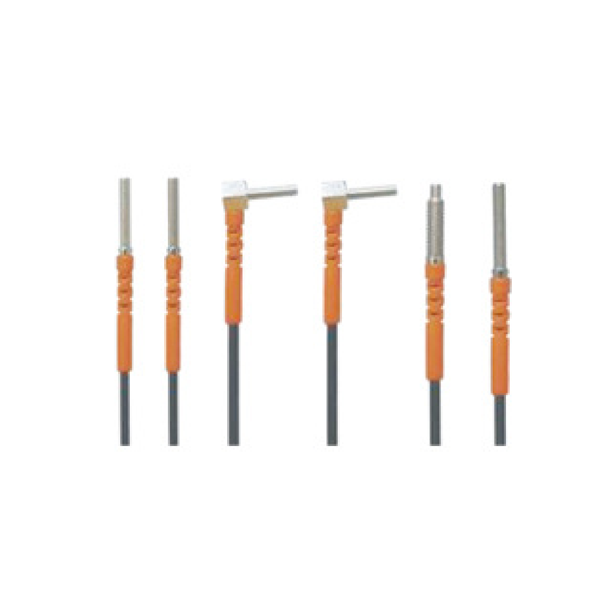
Optical fiber sensors are widely used in industrial inspections. However, optical fiber heads are divided into two types: the collimated type and the reflective type. If the type is not selected correctly, it may result in unstable detection distance or even failure to work reliably. The following are the principles, characteristics and application scenarios of these two types of optical fibers.
1. Intersecting-type optical fiber
Working principle: The transmitting fiber and the receiving fiber are independent of each other and installed face to face. The light emitted from the transmitting end travels through space and is received by the receiving fiber on the opposite side. When the measured object passes between the two, it blocks the light path, generating a switching signal.
Feature:
The detection range is quite long, up to several meters (depending on the power of the optical fiber amplifier);
The detection is not affected by the color, material or reflectivity of the surface of the object being tested (as long as the object can block the light path).
During installation, optical fiber heads need to be placed on both sides of the equipment and the optical axes must be aligned precisely.
Applicable scenarios: Packages on the logistics sorting line are detected for their condition, for the presence or absence of transparent bottles (glass or PET), and for the confirmation of the arrival of long-distance objects, etc.
II. Reflective Fiber Optic
Working Principle: The transmitting fiber and the receiving fiber are integrated in the same cable or the same probe. Light is emitted from the transmitting fiber and shines on the surface of the object being measured. The reflected light from the object's surface enters the receiving fiber.
Feature:
Just install on one side, making wiring convenient;
The detection range is relatively short (usually ranging from a few millimeters to several hundred millimeters).
The detection effect is highly dependent on the reflectivity of the object's surface. For black matte objects, the detection distance will be significantly shorter, and it may even be less than half that of white objects.
Applicable scenarios: Positioning detection of small parts, determination of the presence or absence of objects in a confined space, and detection of workpieces with stable surface reflectivity.
III. Model Comparison
Project Line-of-Sight Type Reflection Type
Installation Method Installed on both sides, requires alignment Installed on one side, wiring is simple
Detection Distance Long (several meters) Short (millimeters to several hundred millimeters)
Affected by Object Color Not affected Significantly affected (color changes in black case)
Typical Applications For long-distance detection, transparent bottles, logistics sorting For small parts positioning in space-constrained environments
IV. Model Selection Suggestions
If you need long-distance detection and the color and material of the object being measured vary greatly, choose the line-of-sight type. It is not picky about the object and measures everything with consistent stability.
The installation space only allows for single-sided wiring. Moreover, the detection distance is short and the reflectivity of the object being measured is relatively consistent. Reflective type will suffice.
It should be noted that the actual detection distance of reflective optical fibers should be determined based on the actual measurement during on-site installation. Especially when the object being measured is black or has a rough surface, sufficient margin should be left or a higher-power optical amplifier should be selected.
The Rihuan sensor is compatible with a full range of beam-type and reflective-type optical fiber heads. It can be flexibly combined with different optical fiber amplifiers to meet various detection distances and installation space requirements. Welcome to follow Rihuan Sensor to obtain professional fiber optic sensing solutions.