Today, Wuxi Rihuan Sensor Technology Co., Ltd. will introduce to you how to select the resolution of safety grating. 14mm, 20mm and 30mm all have corresponding options.
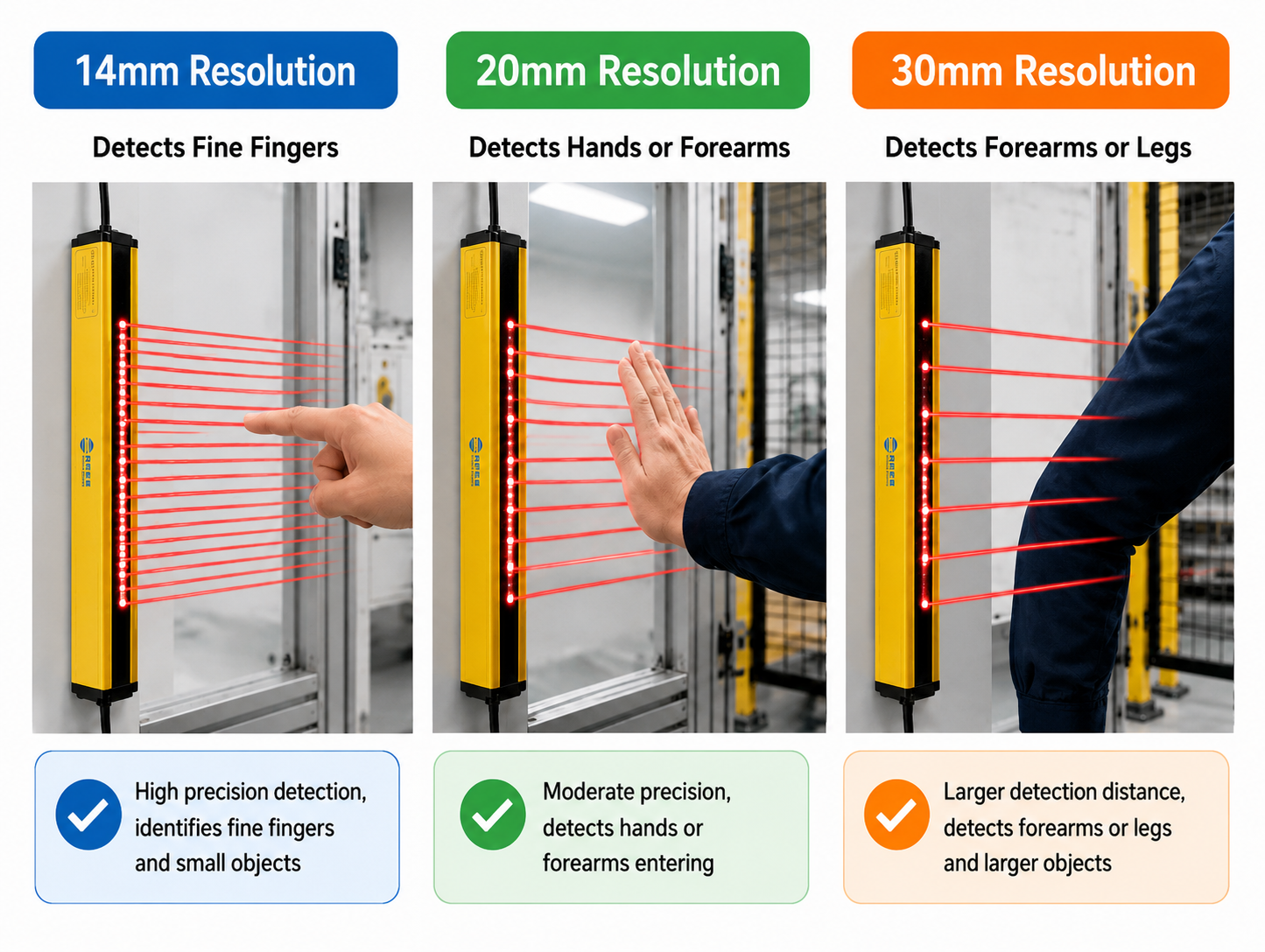
The resolution of a safety grating refers to the smallest object size that the grating can detect. It determines the grating's ability to identify when human body parts or tools enter the dangerous area. Choosing the wrong resolution may result in frequent malfunctions of the equipment, or even more dangerously, the hand may be inserted into the grating but it doesn't react.
Applicable scenarios for different resolutions
14mm resolution
Protected object: Finger
Applicable scenarios: Equipment where fingers may extend into dangerous areas, such as small presses, assembly stations, precision presses, winding machines, etc.
Features: High detection sensitivity, capable of effectively protecting the operator's fingers, but relatively prone to triggering a shutdown due to small foreign objects (such as chips).
20mm resolution
Protected area: Palm or arm
Applicable scenarios: Areas where hands may enter, such as in automated packaging lines, conveyor belt entrances, ordinary shearing equipment, and the periphery of robot workstations.
Feature: Balances protection and human-machine efficiency, it is the most commonly used resolution level in industrial settings.
30mm resolution
Protected area: Arm or leg
Applicable scenarios: Hazardous areas where body parts may come into contact, such as large presses, bending machines, robot enclosures, and entrances/exits of large automated storage areas.
Features: The detection range is wide, suitable for situations where there is no need to protect the fingers but entry by humans needs to be prevented. The rate of accidental shutdown is relatively low.
Consequences of choosing the wrong resolution
Selection error Consequences
Choosing a resolution that is too small (e.g. 14mm for a palm) Fine dust, chips, and the edges of workpieces may also block the light curtain, causing the equipment to frequently stop unexpectedly and affecting production efficiency
Choosing a resolution that is too large (e.g. 30mm for a finger) Hands or small tools can pass through the light curtain without being detected, making the safety protection ineffective and posing a serious risk of personal injury
Core principle of selection
Select the corresponding resolution to protect the corresponding part.
Need to prevent fingers → 14mm
Need to prevent hand contact → 20mm
Need to prevent arm/leg movement → 30mm
If the equipment involves multiple risks (for example, both finger operation and body entry are possible), the most stringent part should be selected for the design, or it can be used in conjunction with an installation method (such as increasing the safety distance).
Other important points to note:
The resolution is directly related to the distance between the optical axis: the smaller the distance between the optical axis, the higher the resolution.
High resolution (such as 14mm) usually means that a greater number of light beams are required, and the cost of the light screen as well as the difficulty of controlling the light will increase accordingly.
Some safety standards (such as GB 4584 and IEC 61496) have specific resolution requirements for certain equipment like press machines. When selecting the equipment, these requirements must be followed.
The safety grating product line of Rihuan Sensing covers various resolutions ranging from 14mm to 60mm. It can be precisely selected based on the risk level of the equipment. Welcome to follow Rihuan Sensing to obtain professional safety protection solutions.