Today, Wuxi Rihuan Sensing Technology Co., Ltd. will introduce the "edge detection algorithm" for measuring light curtains: How to measure a 5mm object with a 10mm light beam spacing?
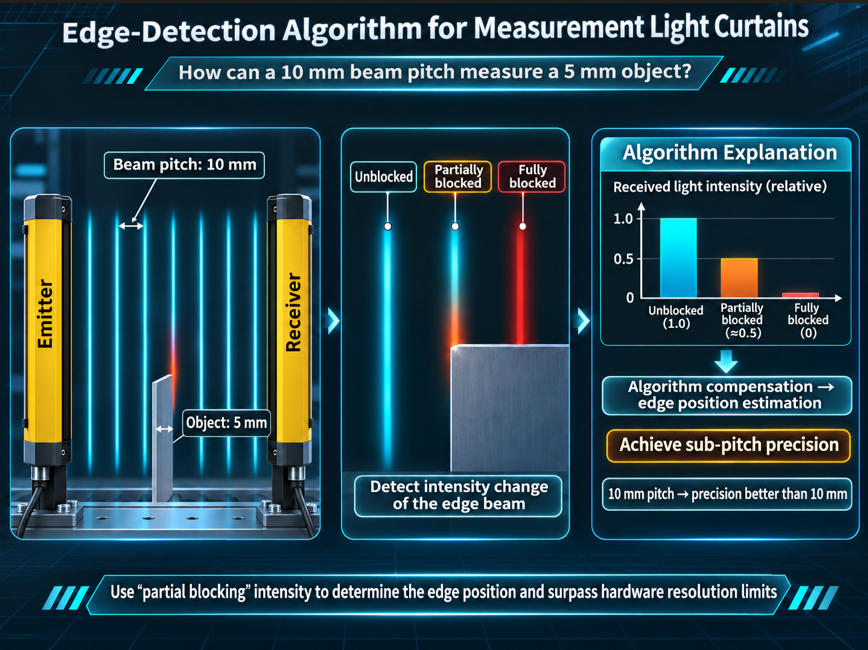
When selecting a measuring light curtain, many people focus on one parameter: the light beam spacing. A 10mm spacing light curtain seems to only be able to measure objects larger than 10mm. However, in the field, contradictions often arise: the workpiece is only 5mm wide, and the budget is not sufficient to purchase a high-resolution model with a 5mm spacing.
Here is a common cognitive bias: The light beam spacing determines the "lower limit of the smallest detectable object", but it is not exactly equivalent to the "upper limit of the measurement accuracy". Through the edge detection algorithm, a 10mm spacing light curtain can indeed "draw the outline of an object smaller than the spacing", but there are strict physical boundaries behind this, not something that magically appears out of thin air.
1. Hardware foundation: The light beam is not a "on/off" switch
Traditional beam-type photoelectric sensors output a switch signal: Light is blocked, it is ON; no light is blocked, it is OFF. However, the receiver of the measuring light curtain is different - the signal strength it outputs is proportional to the received light energy.
When the object edge happens to fall exactly in the middle of a beam of light, this beam of light is not completely blocked. The receiver receives light intensity between "full pass" and "full cut". For example, if it is half blocked, the light intensity drops to 50%; if it is one-third blocked, the light intensity drops to 67%. The controller reads this continuous light intensity value, not a simple on-off state.
2. Algorithm compensation: How to convert "partial blocking" into position
Suppose the light beam spacing is 10mm and the object width is 5mm. The object may only completely block one beam of light, while the light beams on both sides are partially blocked (for example, each blocked 2.5mm). If only looking at "which beams of light are blocked", the algorithm can only draw a vague conclusion that "the object width is between 0 and 10mm".
The edge detection algorithm's approach is: Using the attenuation ratio of the light intensity when a beam of light is partially blocked, reverse to calculate the specific position of the object edge within the coverage of this beam of light. The controller estimates the coordinates of the left and right edges of the object through weighted calculation, thereby obtaining a more detailed size value than the light beam spacing.
Some high-end measuring light curtains do indeed have the ability to "significantly improve resolution without reducing the light axis spacing", relying on this signal-level processing.
3. Physical boundaries: What the algorithm can compensate for, and what it cannot
It must be said precisely: Algorithm compensation cannot break through the physical limit.
What can be compensated for: When the object edge falls within the coverage of the light beam, through the light intensity ratio, determine the "sub-spacing" position of the edge. The prerequisite is that the object can partially block one beam of light, allowing the receiver to perceive the change in light intensity.
What cannot be compensated for: If the object completely falls in the gap between the two beams of light, both beams of light remain 100% illuminated, and the receiver has no signal change. At this time, no matter how advanced the algorithm is, it cannot determine that there is an object in the middle. This is why "the smallest detectable object" is still limited by the light beam spacing - for a 10mm spacing light curtain, for an extremely thin object that completely falls in the gap, there is still a possibility of missed detection.
Therefore, using a 10mm light curtain to measure a 5mm object, whether it can succeed depends on the relative position of the object and the light beam. If the object edge happens to partially overlap with one beam of light, the algorithm can calculate; if the object completely avoids all beams of light, it cannot be detected.
4. Practical engineering suggestions
If the field really needs to use a 10mm light curtain to measure a 5mm workpiece, you can try tilting the light curtain. After tilting by about 45°, the equivalent spacing of the light beam in the horizontal direction will be reduced to approximately 7mm, increasing the probability of light beam overlapping with the object. But this is an installation technique, not the功劳of the algorithm itself.
For workpieces with dimensions close to or smaller than the beam spacing, the safest solution is still to choose a model with a smaller spacing (such as 5mm or 2.5mm). Algorithm compensation is "the icing on the cake", not "a lifesaver in an emergency". When selecting the model, consider "the smallest detectable object" and "measurement accuracy" separately: the former has an upper limit determined by the hardware spacing, while the latter can be refined to a certain extent through the algorithm, provided that the object can be detected.
Rihuan Sensing offers a variety of measurement curtain products with different beam spacing specifications, supporting analog and switch output, and suitable for size measurement and edge positioning scenarios. Welcome to follow Rihuan Sensing to obtain professional measurement curtain selection support.