Today, Wuxi Rihuan Sensor Technology Co., Ltd.will introduce to you how to deal with the "cable connector" loosening problem of proximity switches? - The anti-loosening techniques for M12 connectors.
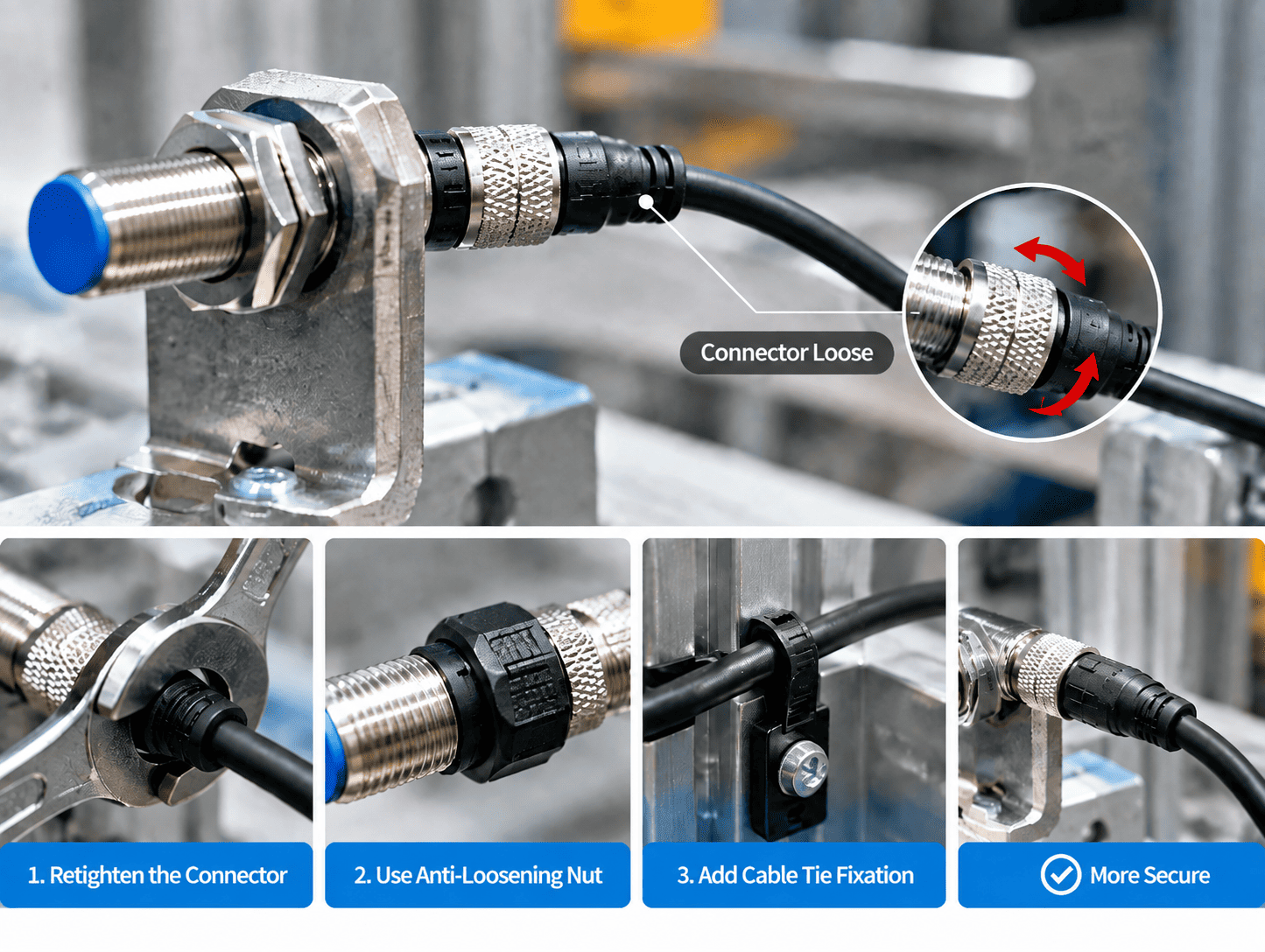
In industrial sites, proximity switchesand photoelectric sensors use M12 circular connectors extensively. However, many engineers have encountered such situations: during equipment operation, the signal is intermittent. After thorough troubleshooting, it was eventually discovered that it was just the M12 connector that was loose.
According to on-site statistics, up to 35% of sensor signals experience transient disconnection or failure. The root cause is merely the poor contact of the terminals of the M12 connector. In a vibrating environment, the originally tightened M12 nuts may experience a slight loosening due to micro deformation, causing the internal pins and sockets to become visibly loose, resulting in signal disconnection.
Here is a complete anti-loosening solution from selection, installation to daily maintenance.
1. Select the right connector: Anti-loosening design is key
Ordinary M12 connectors rely solely on the pre-tightening force of the outer metal nut to maintain the physical connection. When the machine starts, the low-frequency mechanical shock and high-frequency spindle vibration combined to form resonance waves, gradually overcoming the frictional force between the threads, causing the connection to loosen.
Solution: Select connectors with anti-loosening design.
1. Worm gear locking structure
M12 connectors with anti-loosening worm gear nuts have an internal precision anti-loosening gear ring or wave spring washer. After the nut is tightened, the internal anti-loosening mechanism will bite and lock, and any torque attempting to reverse the nut must first overcome the mechanical potential energy of the worm gear structure.
This design is very effective: in 10-500Hz vibration tests, the torque retention rate is ≥ 90%, and the contact resistance fluctuation is ≤ 5mΩ. In a high-frequency vibration environment, the vibration displacement of the connector can be strictly controlled within 0.05mm, completely eliminating signal interruption caused by mechanical loosening.
2. Anti-vibration loosening thread structure
Some M12 connectors adopt straight or double-woven thread designs. After tightening, in 10-2000Hz frequency band and 15g acceleration vibration tests, the connection impedance change is extremely small. Some connectors also use a dual-locking structure of thread locking and anti-vibration loosening nuts, which can withstand high-frequency vibration and mechanical impact.
3. Dual-stable locking mechanism
Some connectors use a dual-stable locking mechanism - when the terminals are fully engaged, regardless of the magnitude of vibration, the plug and socket can maintain a firm connection, ensuring stable signal transmission.
Selection suggestion: For sensors installed on strong-vibration equipment such as robotic arms, stamping equipment, and AGV, prioritize M12 connectors with anti-loosening worm gears or dual-stable locking mechanisms instead of ordinary thread locking types.
2. Standard installation: Using the correct torque is key
Many on-site engineers rely solely on their hands to tighten M12 connectors - "Just tighten it." But this is extremely unreliable: if it is too loose, it will loosen after a few vibrations; if it is too tight, it may damage the O-ring or the threads.
Correct approach: Use a torque wrench and follow the standard torque for tightening.
The standard locking torque for M12 connectors is usually 0.4-0.6 Nm. Some brands recommend values of 0.6-1.2 Nm, which should be based on the product manual.
Beckhoff clearly recommends: Use a torque wrench to tighten the M12 connector to 0.6 Nm. SICK also provides a dedicated M12 torque wrench (0.6 Nm) as an accessory. Some brands suggest 0.7-0.9 Nm.
Key points of operation:
Check the internal O-ring and the opposite sealing surface for cleanliness before tightening. There should be no dust or foreign matter.
First, use your hand to screw the nut all the way down, then use the torque wrench to lock it according to the standard torque.
Never just rely on your hands to tighten to ensure that the O-ring reaches the designed deformation compression rate.
If there is no torque wrench on site, a dedicated M12 tightening tool (such as Screwty®) can be used. A simple rotation can tighten the connector without excessive force.
III. Supplementary Measures: Thread Sealant and Anti-loosening Washers
For particularly intense vibration scenarios, additional anti-loosening measures can be added on top of the standard torque tightening.
1. Thread Sealant (Thread Sealant)
Apply an appropriate amount of thread sealant (an adhesive) to the M12 threads. After curing, it forms a hard thermosetting plastic that effectively prevents loosening caused by impact and vibration. It is suitable for locking and sealing M2 to M12 threads.
Common models include Loctite 243 (moderate strength, detachable) and Loctite 263 (high strength). Note: The thread sealant should be applied to the threads before the connector is installed, and the curing time is usually 20 minutes to 24 hours.
2. Anti-loosening Washers
Add anti-loosening washers (such as serrated locking washers, wedge-shaped locking washers) between the nut and the equipment. This increases friction resistance mechanically and prevents vibration from causing disengagement.
IV. Daily Inspection: LED-Indicated Connectors Make Fault Location Easier
1. Select Connectors with LED Indicators
Some M12 connectors are integrated with LED indicators, which can directly show the power or signal status. When the connector loosens and causes a signal interruption, the LED will go out or flash, helping to quickly locate the fault point without having to check one by one.
2. Shake Test Method
When suspecting a loose connector, perform a shake test: reconnect and power on, then gently shake the connector and cable. Observe if the signal is intermittent or flashing. If the signal is interrupted during the shake, it can generally be determined that the connector is loose or there is internal contact failure.
3. Regular Re-tightening
It is recommended to re-tighten M12 connectors with a torque wrench once every six months. For high-vibration equipment (press machines, robots, etc.), the re-tightening frequency should be appropriately increased.
Summary
Anti-loosening Measures Applicable Scenarios Key Points
Ratchet Locking Connectors High-frequency vibration equipment (robots, presses) Internal anti-loosening gears bite and lock, vibration displacement ≤ 0.05mm
Torque Wrench Tightening All M12 Connector Installation Standard Torque 0.4 - 0.6 Nm,严禁 by hand
Thread Sealant Severe Vibration, Difficult Frequent Maintenance Scenarios Applicable to M2 to M12 threads, cured for anti-impact and vibration
Anti-loosening Washers Highly Vibratory Installation Points Increase friction resistance to prevent disengagement
LED-Indicated Connectors LED directly shows signal interruption
Signal interruptions caused by M12 connector loosening account for more than one-third of on-site sensor failures. Select connectors with anti-loosening design, use the correct torque wrench, and when necessary, add thread sealant - follow these three steps, most loosening problems can be avoided in advance, and there is no need to wait for the signal to go out before conducting a full-site inspection.
Rihuan SensingSupplies provides high-quality M12 connection cables, supporting anti-loosening ratchet nuts for shock-resistant models, suitable for various vibration environments. All cables are pre-tightened according to standard torque specifications upon factory shipment to reduce on-site installation errors. Welcome to follow Sensor Sensing for more reliable sensor connection solutions and technical support.