Today, Wuxi Rihuan Sensor Technology Co., Ltd. will introduce to you how safety gratings are used in AGVs - the safety protection of automatic guided vehicles.
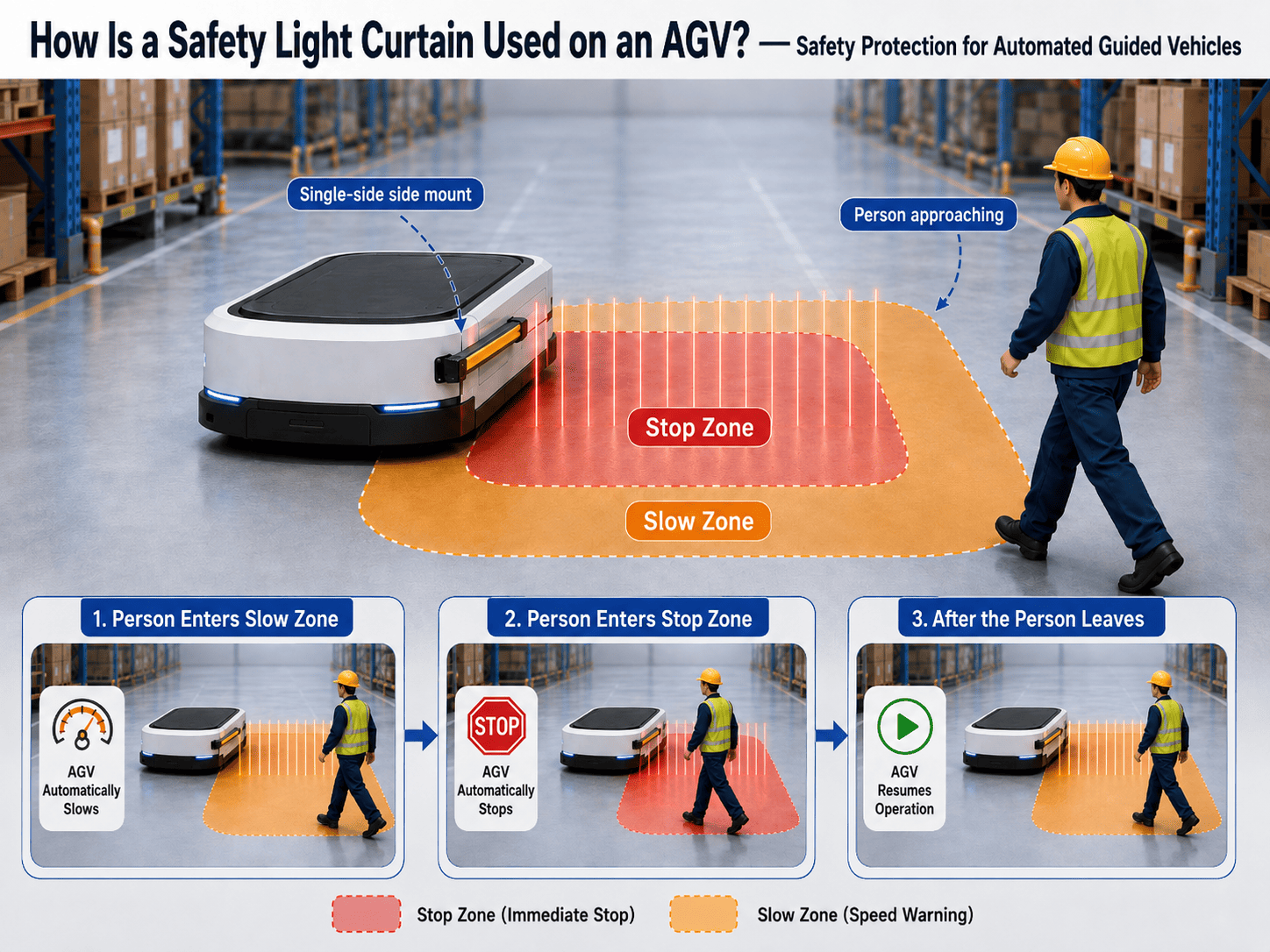
With the rapid development of flexible manufacturing and intelligent logistics, AGVs (automatic guided vehicles) are becoming increasingly popular in factories and warehouses. These mobile devices move between people and materials, and the safety protection on their running paths has become a matter that must be seriously addressed. By setting safety gratings on the AGV's running path, when people or obstacles enter the path, the AGV can stop immediately to avoid collisions. However, unlike fixed equipment, AGVs have more specific requirements for safety gratings.
1. Why do AGVs need safety gratings?
Traditional safety gratings are mostly used for the entrance and exit protection of fixed equipment. In the AGV scenario, the protection object has changed from "fixed dangerous points" to "moving equipment" - the gratings must move with the vehicle and dynamically detect obstacles and people on the running path.
AGVs use safety gratings mainly for obstacle avoidance during movement: installed at the front of the AGV body, they detect obstacles or people on the moving direction and trigger deceleration or emergency stop. In some scenarios, they are also used for workstation safety interaction, achieving safe linkage when the AGV connects with the machine.
2. Three key selection points for AGV scenarios
Point 1: Resistance to vibration - the optical axis cannot "shake" with the vehicle
During the movement of AGVs, they encounter uneven ground, bumps, start-stop impacts, and ordinary gratings' installation brackets and internal structures are difficult to withstand such continuous vibration. Vibration can cause the optical axis to shift, resulting in intermittent signals.
When selecting, attention should be paid to:
Choose safety gratings with anti-vibration and anti-shock design, which have strong tolerance to shocks and vibrations.
Use anti-vibration brackets or shock-absorbing pads when installing to reduce the direct transmission of vibration to the gratings.
Regularly check if the screw bolts of the brackets are loose to ensure the gratings are in a properly aligned state.
Point 2: Fast response - a millisecond-level reaction is necessary to stop
The speed of AGV movement is usually 0.5 to 2 m/s. When encountering obstacles, it must react in an extremely short time; otherwise, the braking distance will be too long, directly leading to a collision.
The standard response time for industrial safety gratings is usually ≤ 20 ms.
Some high-performance products have a response time of ≤ 10 ms or even millisecond level, far exceeding the reaction speed of mechanical braking systems.
When selecting, note that the shorter the response time, the shorter the safe braking distance of the AGV, and the gratings can be installed closer to the dangerous area.
Point 3: Protection level - AGVs operate in various environments
The working environment of AGVs is diverse - from clean workshops to dusty warehouses, from indoor to semi-outdoor, and requires high environmental adaptability for gratings.
The IP67 protection level is currently the mainstream standard for safety gratings used in AGVs, dustproof and waterproof, suitable for humid and dusty environments.
For outdoor or extreme environments, some products have a protection level of IP68 or even IP69K.
For dusty workshops, select models with anti-dust interference capabilities; in environments with strong electromagnetic interference, select products with anti-electromagnetic interference design.
3. Two installation methods: channel type and vehicle-mounted type
Channel type installation (fixed gratings)
Install safety gratings on both sides of the AGV's running path, forming an infrared light beam protection barrier. This method is suitable for fixed paths of AGVs, with a range of up to several meters or even tens of meters. However, the disadvantage is that holes need to be drilled on both sides of the path for wiring, resulting in a longer construction time.
Vehicle-mounted installation (single-sided gratings)
Install gratings directly on the front or sides of the AGV body, moving to detect. Compared to traditional beam-type gratings, single-sided gratings integrate the emission and reception, forming a detection light curtain with a single side deployment, which is small in size and flexible in installation. It shows significant advantages in scenarios with complex AGV travel paths and limited space.
IV. Interconnected Control: Coordinated with the AGV Scheduling System
A single safety sensor can only achieve a simple closed loop of "detection → stop". In AGV scenarios, a better solution is to link the safety sensor with the AGV scheduling system and the equipment PLC.
Typical interconnection logic includes:
Hierarchical Response: When entering the warning zone (1-3 meters from the equipment), the AGV slows down; when entering the danger zone (< 1 meter), it immediately stops.
Automatic Recovery: After personnel or obstacles leave, the system automatically verifies the environment and quickly resumes operation.
Interconnection with Navigation System: The AGV scheduling system is linked with the machine safety sensors. When the AGV arrives, it sends a signal in advance to achieve safe coordination.
V. Daily Maintenance Key Points
The safety sensors used for AGVs move with the vehicles, which is more susceptible to vibration and collision than fixedly installed sensors. Daily maintenance is particularly important:
Daily Start-up Inspection: Confirm that the sensor is powered on, the indicator light is normal, and there are no error lockups.
Regular Cleaning: The AGV operating environment is diverse, and the lenses are prone to dust or oil stains, so they need to be wiped regularly.
Alignment Check: Regularly check the alignment status of the sensor and adjust it in time if the optical axis is offset.
Bracket Tightening: Check the installation bolts once a quarter to prevent loosening due to vibration and prevent the sensor from shifting.
Summary
Selection Dimension Key Requirements
Anti-Vibration Anti-shock design, vibration-proof brackets or shock-absorbing pads
Response Time ≤ 20ms (standard), ≤ 10ms (high-performance)
Protection Level Starting from IP67, select IP68/IP69K for harsh environments
Installation Method Channel-based (fixed path) or vehicle-mounted (flexible path)
System Interconnection Linked with AGV scheduling system, PLC, hierarchical response
The Rihuan Sensor provides a series of safety sensors for AGV mobile robots with response speeds in the millisecond range, protection levels covering IP67 and above, and supports interconnection control with the AGV scheduling system and equipment PLC. Welcome to follow Daystar Sensor to obtain professional AGV safety protection solutions and technical support.