Today, Wuxi Rihuan Sensing Technology Co., Ltd. will introduce to you what the "blanking" function of safety grating is? What are the differences between fixed blanking and floating blanking?
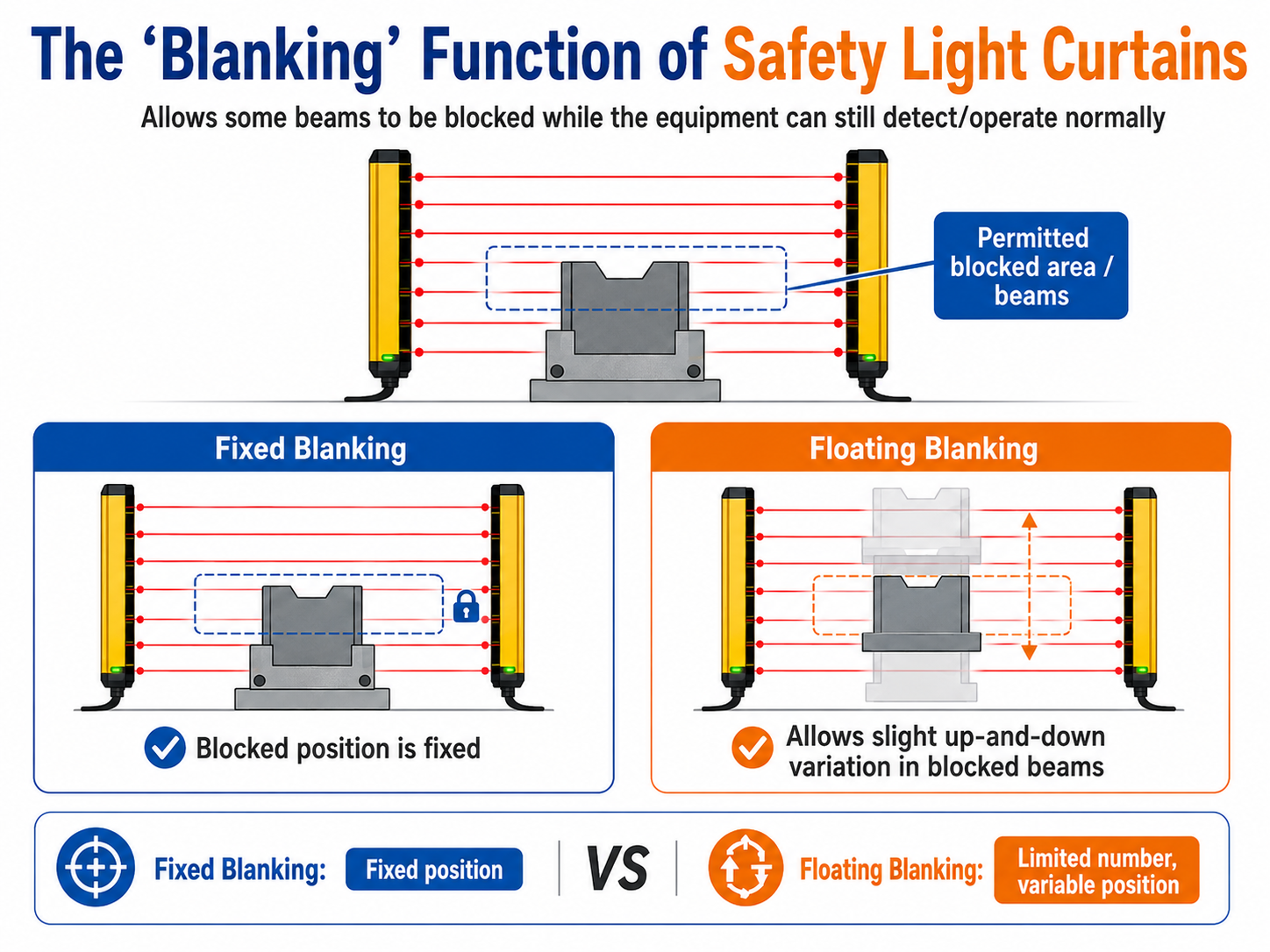
In many scenarios of industrial automation, safety grating faces a contradiction: on the one hand, it needs to protect the safety of operators; on the other hand, the workpieces, pallets or materials themselves must enter the area covered by the light curtain. If the grating stops immediately when it is blocked, the production line cannot operate normally.
At this time, a solution that can "allow passage" of materials and does not reduce safety levels is needed - the blanking (Blanking) function.
1. What is blanking?
Blanking is an auxiliary function of safety grating. It allows a pre-defined number of light beams in the protected area to be blocked without triggering a safety shutdown. In simple terms, it tells the grating: "These several beams of light being blocked is normal, do not alarm, continue working."
Why is this function needed? Because in many production scenarios, materials or equipment components inevitably enter the protected area of the light curtain. For example:
On the automatic conveying belt, the pallet or the workpiece must pass through the light curtain and enter the dangerous area.
In the injection molding machine, the mechanical hand needs to extend into the interior of the light curtain to pick up the parts.
On the automated packaging line, the materials themselves will block some of the light beams.
If there is no masking function, these normal material passes will cause the equipment to frequently stop and the production efficiency to drop significantly.
However, it should be particularly noted that: masking is not turning off the safety function, but allowing some light beams to be blocked under specific conditions. The remaining detection area of the grating still maintains complete resolution and protection capability. After enabling the masking function, due to the change in detection capability, it may be necessary to recalculate the safety distance.
II. Fixed Masking: Fixed "Window"
Fixed masking means disabling a group of position-fixed light beams in the protected area of the safety light curtain. This group of masked light beams remains in an "ignored" state throughout the production process, and objects or materials cannot move in the dangerous area.
For example: Fixed masking is like opening a fixed position "window" on the light curtain - objects can only pass through this fixed position, and the size and position of the window are pre-set.
Typical application scenarios:
The workpiece always enters the dangerous area from the same fixed position
The pallet on the conveyor belt passes through the same position of the light curtain each time
The mechanical hand extends into the operation area from a fixed passage
In simple terms, fixed masking is suitable for situations where the object position remains unchanged. If the position of the workpiece within the protected area changes, fixed masking cannot cope.
III. Floating Masking: "Dynamic Window" Following Movement
Floating masking is more flexible. It only sets the number of masked light beams, without limiting the specific position of the masking area. That is to say, the masked light beams can move with the movement of the material.
Using the "window" analogy again: Floating masking is like a "dynamic window" following the movement of the material - wherever the material goes, the "window" opens there. The premise is that the number of light beams blocked by the material at any time does not exceed the pre-set quantity, and these blocked light beams must be adjacent.
Floating masking has two sub-types:
Normal floating masking: Allows the object to freely move within the protected area
Required object presence floating masking: Requires the masked light beams to be in a blocked state during the masking period - that is, the object must always remain within the protected area, and the grating will remain in the ON state; if the object leaves, the grating will immediately trigger a safety stop
Typical application scenarios:
The workpiece moves on the conveyor belt, and its position changes constantly
Large workpieces need to move during the processing
Materials pass through the protected area along different paths
Floating masking is particularly suitable for situations where materials move within the dangerous area. Materials can move freely within the protected area as long as they do not block more than the set number of light beams, and the grating will not trigger a stop.
IV. Fixed Masking vs Floating Masking: One Table to Understand
Comparison item Fixed Masking Float Masking
Masking area Position fixed Follows the movement of the material
Setting method Specify which beams of light are masked Specify the number of masked light beams
Can the object move Not allowed to move in the dangerous area Can move in the dangerous area
Monitoring logic Ignore a fixed number of light beams in the position Do not stop the machine as long as the number of blocked light beams does not exceed the set quantity
Applicable scenarios Objects position remains unchanged Objects move within the protected area
The masking area of fixed masking is precisely defined in size and position; while floating masking only defines the size (i.e., the number of light beams) of the masking area, not its position within the protected area. This means that floating masking can dynamically adapt to the movement of materials within the protected area.
V. Safety Precautions for Using the Masking Function Although the dimming function improves production efficiency, it also introduces a potential risk: What if someone enters the dangerous area through the dimmed area?
The safety standards (such as IEC/TS 62046) have clear requirements for the dimming function:
It is necessary to ensure that no one can enter the dangerous area through the dimmed area by means of design (such as covering the remaining space or installing additional protective devices)
Before using the dimming function, a risk assessment of the application must be conducted to confirm whether the specific application allows the use of the dimming function
After using the dimming function, it may be necessary to recalculate the safety distance
In simple terms: Dimming is not "turning off" protection, but "precisely controlling" the scope and method of protection.
The safety light curtain products of Rihuan Sensing support fixed dimming and floating dimming functions, which can be flexibly configured according to the requirements of the on-site material conveying. It can maximize production line efficiency while ensuring the safety of personnel. The product complies with the IEC 61496 safety standard. Welcome to follow Rihuan Sensing and obtain professional safety protection solutions.