Today, Wuxi Rihuan Sensor Technology Co., Ltd. will introduce to us how much is the "fiber bending radius" of the optical fiber sensor? And what will happen if the bending is too sharp?
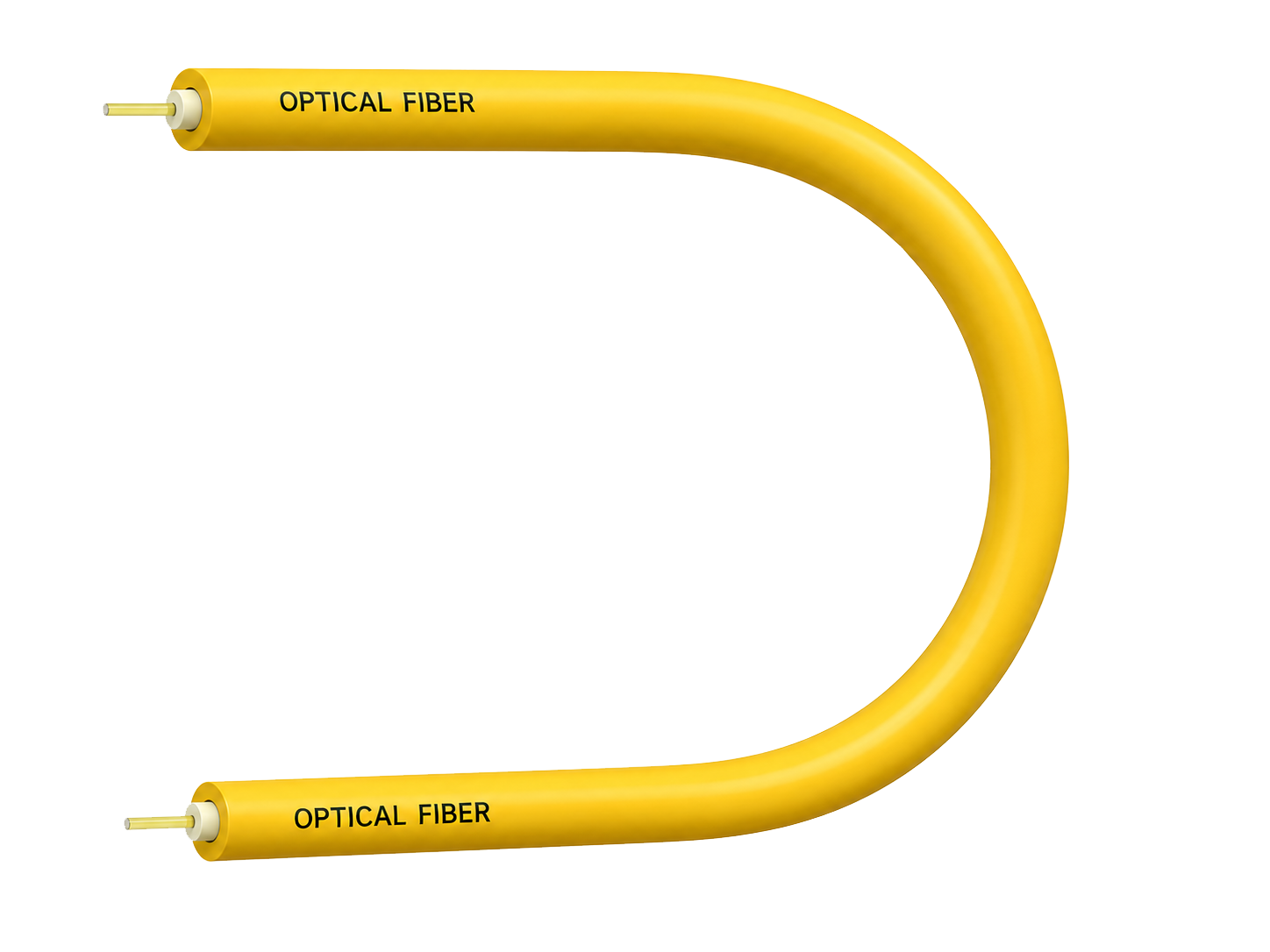
Optical fiber sensors are widely used in industrial inspection. One of their core advantages is that the optical fiber itself is flexible and can be bent, allowing for flexible wiring in narrow spaces. However, "bendable" does not mean "bend freely" - each optical fiber has a minimum bending radius limit. If bent too sharply, even slightly, the signal will be attenuated and the detection will be unstable; if the bending is too severe, the fiber may break and the sensor may be scrapped.
1. What is "minimum bending radius"?
The minimum bending radius refers to the smallest radius within which an optical fiber can be bent without causing significant optical loss or physical damage. This radius is usually measured as the shortest distance from the center axis of the fiber to the point of bending and is expressed in millimeters (mm).
The minimum bending radius varies for different fiber materials and structures:
Plastic optical fibers have better flexibility and allow a relatively smaller bending radius.
Glass optical fibers (silica optical fibers) are more brittle and more sensitive to bending, requiring a larger bending radius.
Taking Omron's optical fiber sensor as an example, its product manual clearly states: the bending radius of the optical fiber cable should be above 20mm. For right-angle bends, the recommended minimum bending radius is 25mm to maintain the rated detection distance. Although the most acute right-angle bend can be performed at a radius of 10mm, this will result in a shortened detection distance.
For common optical fiber patch cords, the standard recommendation is: static bending radius ≥ 20mm, dynamic bending radius ≥ 40mm. This means that for static installation (static) and repeated bending during use (dynamic), the requirements for the bending radius are different - the dynamic use requires a larger bending radius.
2. What happens if the bending is too sharp?
1. Signal attenuation, shortened detection distance
The principle of optical fiber transmission is total internal reflection - light continuously reflects forward at the interface between the core and the cladding. When the fiber bends, some light changes its incident angle at the bending point, which is less than the critical angle, and cannot be reflected but penetrates the interface to form a lost field, causing light energy loss. The smaller the bending radius, the greater the loss.
For industrial optical fiber sensors, this loss directly results in: the light signal reaching the receiving end is weakened, the sensor's detection distance is shortened, or the detection ability for small objects is reduced. Omron clearly states that although a sharp right-angle bend at a radius of 10mm is physically feasible, it will result in a shortened detection distance.
2. Unstable signals, unreliable measurement results
When the bending radius is close to or less than the critical value, the optical loss will increase significantly. For measurement-type optical fiber sensors, the fluctuation of the light signal will directly affect the measurement accuracy and stability. Fiber bending will cause loss, reduce the strength of the sensing signal, and in extreme cases, even cause the disappearance of the sensing signal.
3. Fiber breakage, complete报废
The optical fiber itself is a glass or plastic fiber, and excessive bending or repeated bending will cause internal fractures. Once the fiber breaks, the light signal cannot pass through, and the sensor completely fails, requiring the replacement of the fiber head. It is particularly important to note that the root of the fiber plug is the most vulnerable part to bending stress, and bending stress should be avoided at this point.
3. Practical rules for correct wiring
1. Remember the minimum bending radius
The bending radius of industrial optical fiber sensors is usually not less than 20mm. For right-angle bends, it is recommended not to be less than 25mm. The fiber head should not be bent within 15mm from the sensor.
2. The first and last bends are particularly important
Starting from the output end of the amplifier, the first bending point should be at least 20mm away from the amplifier; the last bending point near the sensing head should also be at least 20mm. These two positions are the areas with the most concentrated stress on the fiber.
3. Prohibited behaviors
Do not stretch the optical fiber cable forcefully
Do not step on the optical fiber cable or place heavy objects on it
Do not bend beyond the allowed bending radius Do not bend the edges of the optical fiber (at the plug base)
Do not apply more than 1kg or 3kg of force to the optical fiber unit (the fiber is very thin, so extra care is required)
4. Fixation and Protection
Use nylon cable ties or wire clips to fix the optical fiber cable
Avoid using U-shaped cable ties that may press on the fiber
For environments with strong vibrations, you can coil the fiber to absorb vibrations
IV. Reference Values for Different Fiber Types
Fiber Type Minimum Curvature Radius (Reference) Explanation
Industrial Fiber Sensor (General) ≥20mm Standard of mainstream brands such as Omron
Right-angle Bend ≥25mm Recommended value to maintain the rated detection distance
Optical Fiber Patch Cord (Static) ≥20mm After fixed installation
Optical Fiber Patch Cord (Dynamic) ≥40mm Used in repeated bending
Bend-Resistant Fiber Can be as small as 1mm Special design, loss < 0.2dB Summary
The bending radius of an optical fiber sensor is not a parameter that can be treated casually. 20mm is the minimum threshold for most industrial optical fiber sensors - below this value, the light signal decays and the detection distance shortens; far below this value, the fiber may break directly. The golden rule for wiring is: leave sufficient space for the fiber to bend, the bend should be gentle, the pull should be light, and the root should be protected.
The Rihuan Sensor is compatible with a full range of optical fiber sensors and fiber units, providing standard type, bend-resistant type and other various optical cable options to meet the needs of different wiring environments. Welcome to follow Rihuan Sensor to obtain professional fiber optic sensing solutions.