Today, Wuxi Rihuan Sensing Technology Co., Ltd. will introduce to us how to calculate the "tracking speed" of color mark sensors and at what speed should the packaging line run to avoid marking errors?
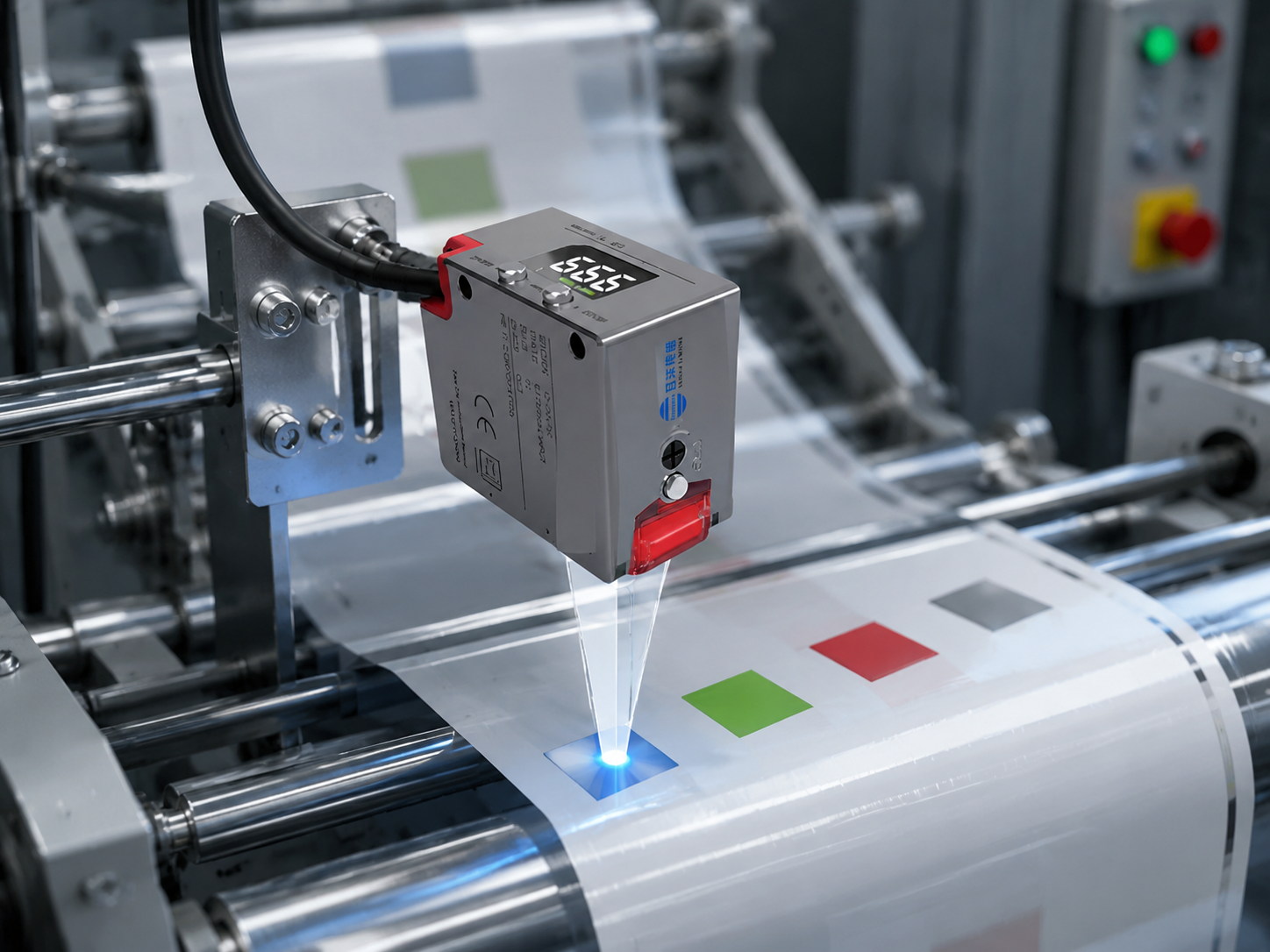
On the automated production lines for packaging, printing, bag-making, etc., color mark sensors are responsible for identifying the color marks on the packaging film and providing positioning signals for the cutting knives or sealing machines. The higher the production line speed, the higher the requirement for the response speed of the sensors. If the response of the sensors cannot keep up, the color mark passes by too quickly and the sensors haven't had time to react before it's over - defective marking, incorrect cutting, and product scrapping follow one after another.
I. Core Concept: Response Time
When selecting color sensor models, the parameter directly related to tracking speed is response time. It is defined as the time required for the sensor to receive the color signal and for the output state to change, usually measured in milliseconds (ms) or microseconds (μs).
The shorter the response time, the faster the color mark can be detected by the sensor.
II. Calculation formula: Color code duration vs. Sensor response time
To determine whether the sensor can keep up with the production line speed, the key is to compare these two times:
Color mark time = Color mark length ÷ Production line speed
For the sensor to function reliably, the following conditions must be met:
Color code: Time > Sensor response time
If the time taken for the color mark to pass is less than or equal to the sensor's response time, the sensor will be unable to complete the signal processing during the color mark's passage, resulting in a missed detection.
III. Example Calculation
Parameters Values
Color mark length 4 mm
Production line speed 200 m/min (≈ 3333 mm/s)
Time for color mark passage 4 ÷ 3333 ≈ 1.2 ms
If a color mark sensor with a response time of 1 ms is selected → 1.2 ms > 1 ms, it can barely keep up, but there is almost no margin. A slight wear or positional deviation of the color mark may result in missed detection.
If a sensor with a response time of 0.1 ms (100 μs) is selected → 1.2 ms is much greater than 0.1 ms, there is sufficient margin, and the operation is stable and reliable.
IV. Selection Principles: At least reserve 2 to 3 times of margin
From a formulaic perspective, as long as the color mark passing time is greater than the response time, it is acceptable. However, in practical engineering, factors such as color mark length, film tension, printing deviation, and environmental light interference can all affect the actual detection. Therefore, it is recommended:
When selecting the type, the response time of the sensor should be much shorter than the time it takes for the color mark to pass, leaving at least 2 to 3 times of margin.
Taking the 200m/min production line and 4mm color mark as an example: the time for the color mark to pass is 1.2ms. It is recommended that the sensor response time should not exceed 1.2 ÷ 3 ≈ 0.4ms (i.e., 400μs). The shorter the response time, the stronger the redundancy capability to cope with fluctuations in the production line speed and changes in the quality of the color mark.
V. High-frequency response also requires attention to switching frequency
The response time refers to the delay of a single detection, while the switching frequency (in units of Hz) refers to the maximum number of on-off cycles that the sensor can complete per second.
The relationship between switching frequency and response time: Switching frequency ≈ 1 / Response time
For example:
Response time 1ms → Switching frequency approximately 1000Hz
Response time 0.1ms → Switching frequency approximately 10000Hz
For high-speed production lines, both of these parameters need to be confirmed: The response time determines whether the color mark can be captured, and the switching frequency determines whether the continuous signal changes can be tracked.
VI. Summary
Key Points Explanation
Time for color marking to pass through the production line Length of color marking ÷ production line speed, should be greater than sensor response time
Response time Shorter is better. It is recommended to leave a 2-3 times margin
Switching frequency Influences the upper limit frequency for the sensor to work continuously
Selection for high-speed production lines First choice is color marking sensors with microsecond-level response time
The tracking speed of color marking sensors is not guessed but confirmed through calculation. On high-speed production lines, a 1ms difference in response time may be the difference between "stable operation" and "frequent marking errors".
The color mark sensor series of Rihuan Sensinghas a response speed of microsecond level and is suitable for various high-speed packaging and printing production lines. Welcome to follow Dayuan Sensing to obtain more accurate and stable color mark detection solutions.