Today, Wuxi Rihuan Sensor Technology Co., Ltd. will introduce to you how to select the "spot size" of photoelectric sensors. Both large and small spot sizes have their own unique applications.
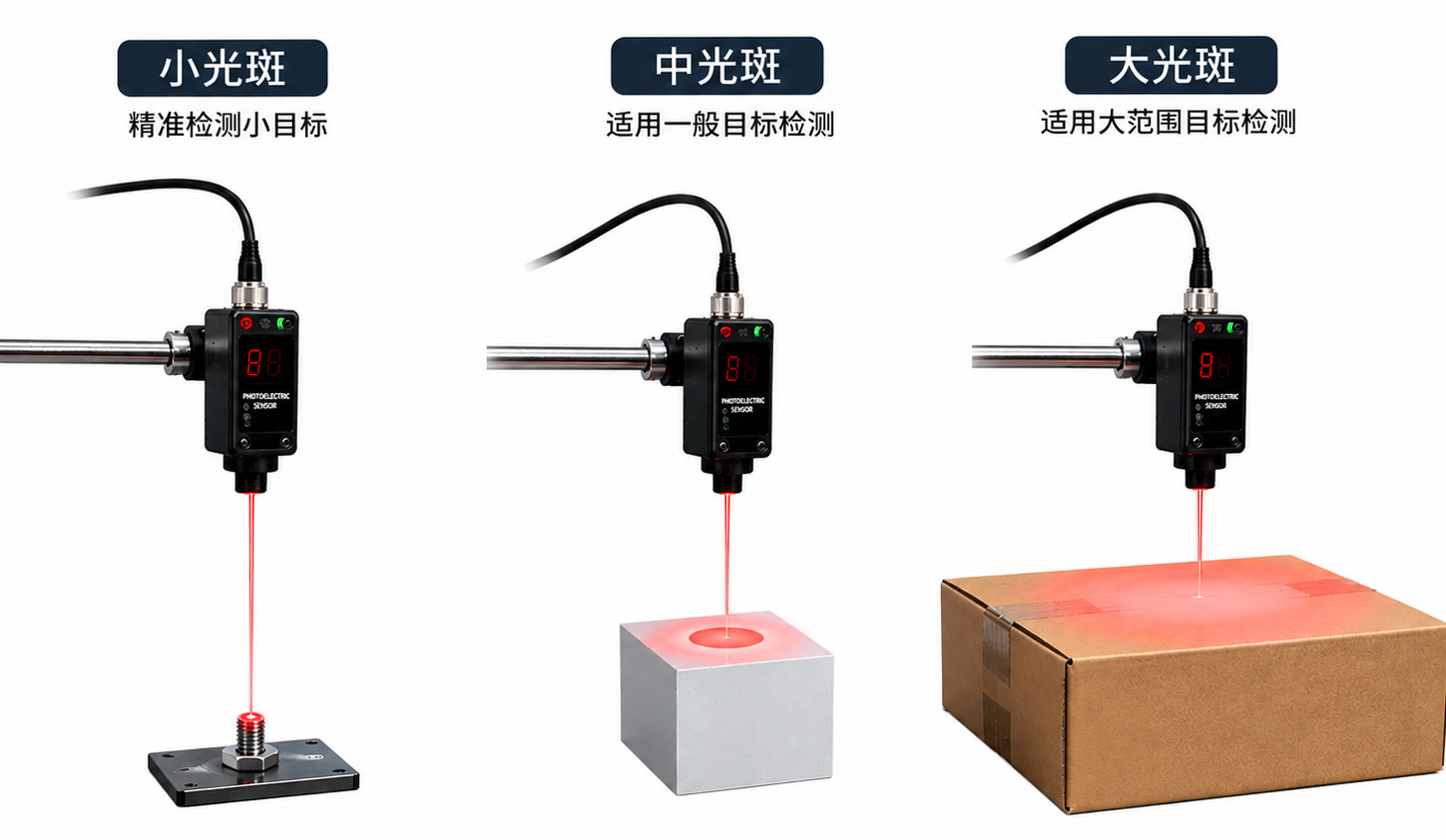
In the selection of photoelectric sensors, the size of the light spot is a parameter that is often overlooked but is of crucial importance. The light spot refers to the area on the target object where the light beam emitted by the sensor is projected. It directly determines the reliability and accuracy of the detection.
Small Spot: Precise Positioning and Small Object Detection
Small spots (typically at the millimeter or even sub-millimeter level) are applicable in the following scenarios:
Detection of tiny objects: such as electronic components, thin wires, and small holes.
Precise positioning: It is necessary to distinguish the edges or specific locations of the target, such as in label detection and gap recognition;
High-density installation: When multiple sensors are installed side by side, the small light spots can reduce mutual interference.
If a large light spot is used to detect a small object, the light beam will simultaneously illuminate both the target and the background. The sensor cannot accurately distinguish between them, resulting in missed detections or incorrect judgments.
Large spot: Rough surface and jitter compensation
Large spots (with diameters ranging from several millimeters to several tens of millimeters) are more suitable for:
Rough or textured surfaces: such as castings, wood, woven fabrics, etc. Small light spots may cause unstable reflection at depressions or protrusions, while large light spots can cover more surface features and achieve an averaged reflection effect, resulting in more stable signals.
Situations with large target jitter: For example, packages that fluctuate in position on a conveyor belt. Large light spots can tolerate positional deviations, preventing the target from moving out of the detection area due to jitter, thereby reducing false triggering.
However, large light spots are not suitable for situations that require precise boundaries or where there are interfering objects nearby. Otherwise, they may simultaneously illuminate adjacent objects, leading to incorrect judgments.
Consequences of Selecting the Wrong Spot Size
Incorrect selection scenarios Consequences
Using a large spot size to measure a small object Light beam covers the background, resulting in low target reflection proportion → missed detection
Using a small spot size to measure rough/oscillating targets Signal is intermittent, frequently triggering false alarms
Selection suggestions
First, clearly define the size, surface characteristics, and motion stability of the object being measured.
Refer to the light spot size and detection distance curve in the product manual to ensure that the light spot can completely fall on the target and avoid background interference when the installation distance is used.
For transparent or highly reflective objects, a comprehensive assessment should also be made by considering the shape of the light spot (such as circular or square spots, etc.).
The photoelectric sensor series from Rihuan Sensing offers a variety of light spot sizes to choose from, along with detailed diagrams of light spot distances, which help users precisely match their on-site requirements. Welcome to follow Rihuan Sensing for professional selection support.