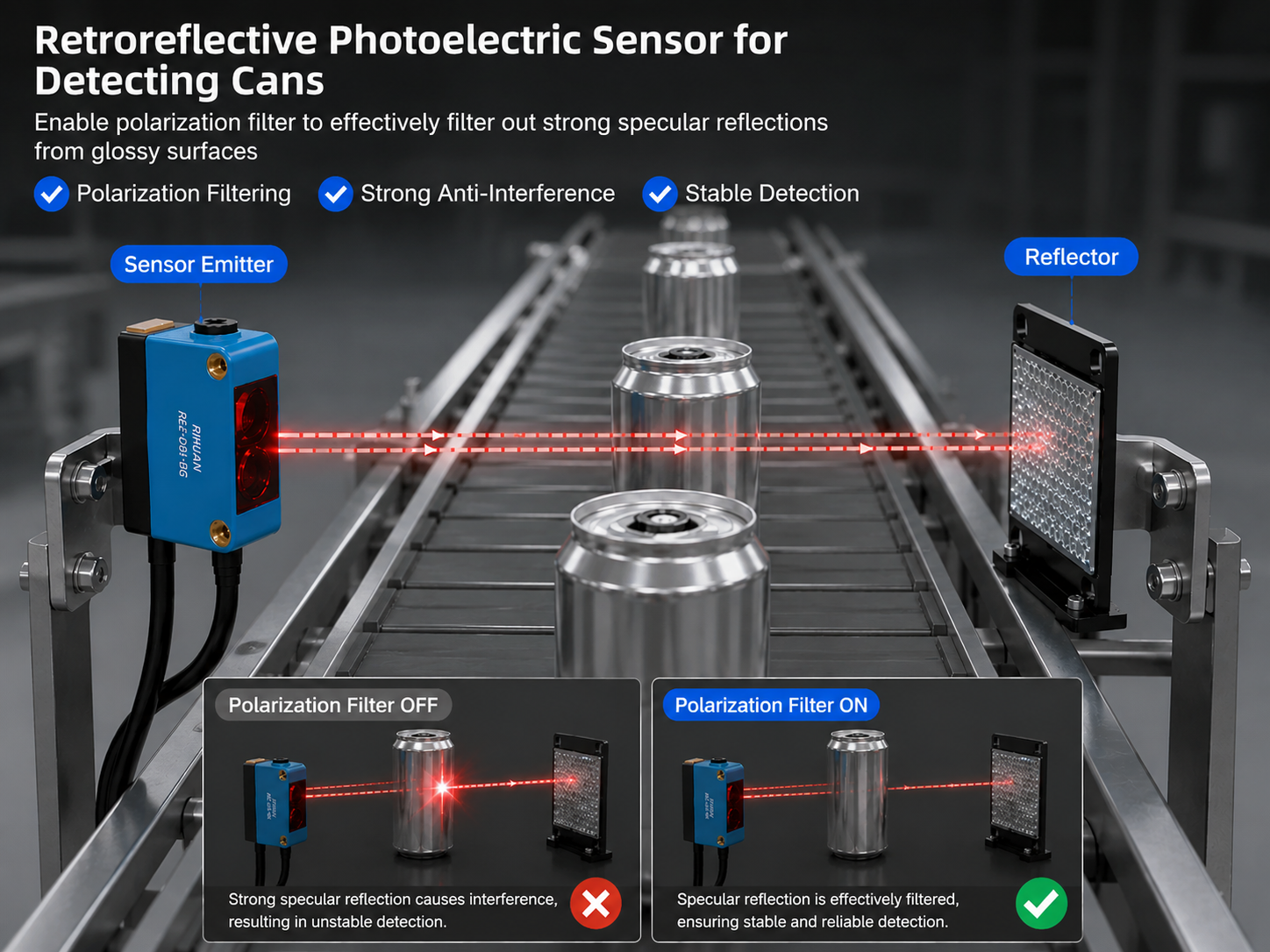
When detecting high-reflective objects (such as mirror-like stainless steel, beverage cans, high-gloss packaging films, shiny metals, etc.), ordinary mirror-reflection type photoelectric sensors often make incorrect judgments: even though there is an object blocking the light, the sensor still outputs a "light transmission" signal, as if it is "blinded". This is because the reflected light is too strong, and the sensor receiver is directly "tricked" by the beam of light reflected back from the mirror surface, unable to distinguish between the true target reflection and the background reflection.
What is the function of a polarizing filter?
The polarizing filter is like putting a pair of "polarizing sunglasses" on the photoelectric sensor. It sets polarizing filters at both the transmitting end and the receiving end, making the transmitted light have a specific polarization direction. When light shines on a mirror-like object, the reflected light basically maintains the original polarization direction; while the reflected light from a diffuse reflecting object will change the polarization direction. By only receiving light of a specific polarization direction, the polarizing filter can effectively filter out the strong mirror reflection light from smooth surfaces, allowing only the diffuse reflection light to enter the receiver, thus enabling the sensor to accurately identify the real target.
Under what circumstances is the polarization function necessary to be enabled?
When the measured object has the following characteristics, a mirror-reflection type photoelectric sensor with polarization filtering function should be selected:
Mirror-finish stainless steel, polished aluminum parts, electroplated parts
Cans, metal sheets, high-gloss coated surfaces
Bright light packaging film, glass (transparent or semi-transparent), glossy plastic
In these scenarios, ordinary photoelectric sensors may suffer from "miss-detection" or "false illumination" due to excessive reflected light, resulting in incorrect operation of the equipment. The polarization filter function can significantly enhance the reliability of the detection.
How to choose?
When selecting the type, priority should be given to mirror-type photoelectric sensors that clearly indicate "with polarizing filter" or "polarization filtering function". The polarization function of some products can be turned on or off by a switch to adapt to different working conditions.
The photoelectric sensor series of Rihuan Sensing can be fully equipped with polarizing filters. It has been optimized for detection scenarios involving high-reflective objects, featuring stable signals and low error rates. We warmly invite you to follow Rihuan Sensing to obtain more reliable photoelectric detection solutions.