Today, Wuxi Rihuan Sensor Technology Co., Ltd. will introduce to you how to deal with the instability of the safety photoelectric barrier transceiver. The five-step troubleshooting method will help you solve the problem quickly on-site.
In industrial automation sites, safety grilles are the core of the collimated beam photoelectric protection devices, used to safeguard dangerous areas and ensure the safety of operators. If the collimation becomes unstable, the equipment may frequently stop running and even pose safety hazards.
Don't rush to replace it. Follow the following five steps to troubleshoot, and most problems can be resolved by yourself.
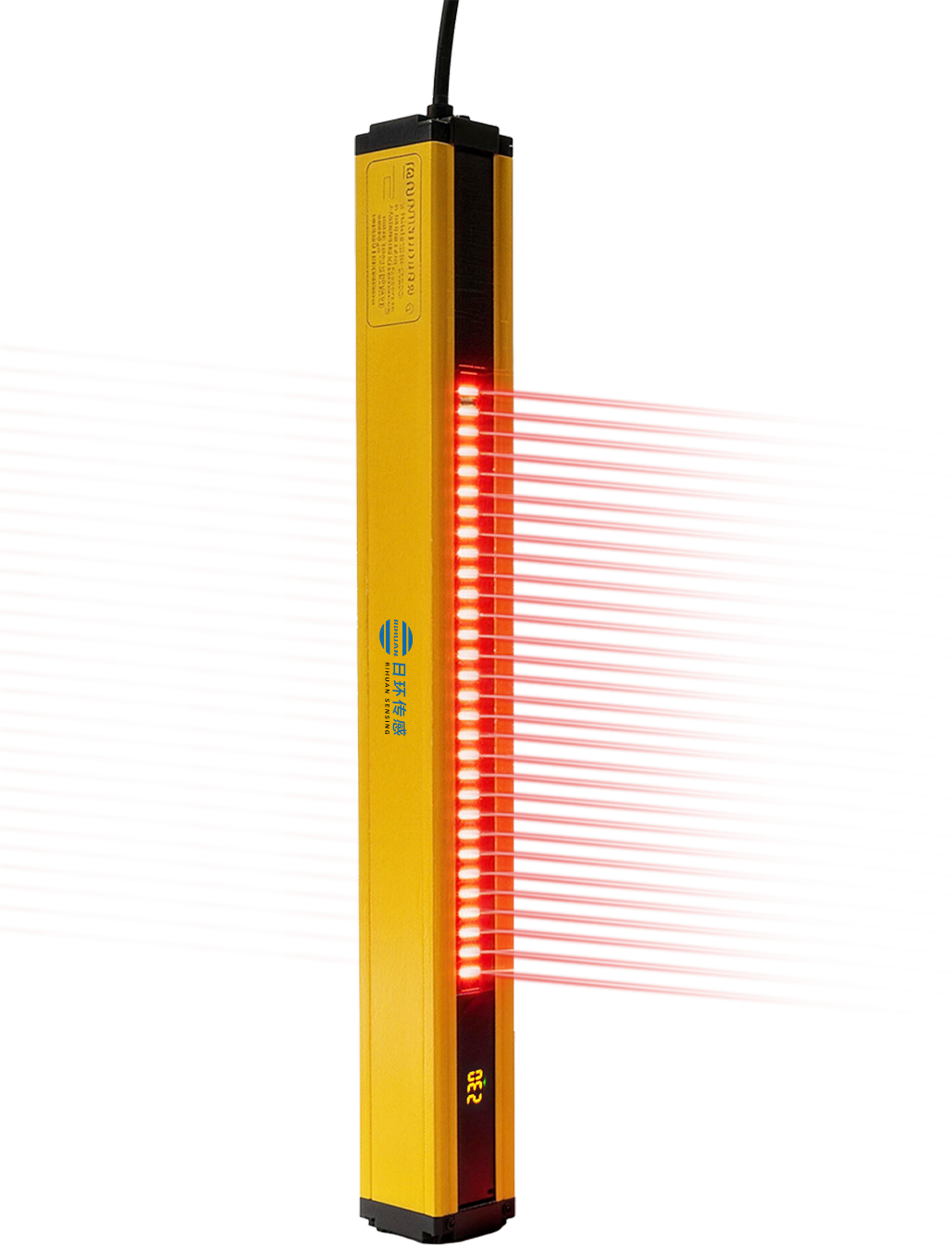
Step 1: Check if the line-of-sight distance exceeds the limit
Each safety photoelectric sensor has a specified line-of-sight distance (such as 3 meters, 5 meters, 10 meters, etc.). If the actual distance exceeds the rated value during installation, the attenuation of the light signal will cause the receiver to fail to accurately identify.
Solution: Re-adjust the installation positions of the emitter and the receiver to ensure the distance is within the allowable range.
Step 2: Verify if the transmitter and receiver are on the same plane
The grating beam detection requires that the optical axes of the transmitter and receiver be strictly aligned. If they are at different heights, misaligned front-to-back, or have a horizontal angle deviation, it will cause the signal to be out of alignment.
Solution: Use a level ruler or laser auxiliary tools to adjust the transmitter and receiver to the same plane and the same height, and ensure that the optical windows are aligned with each other.
Step 3: Clean the surface of the grating and the surrounding environment
Dust, oil stains, water mist or flying debris adhering to the surface of the grating will directly attenuate the infrared light signal. This is the most common "invisible killer" in the field.
Solution: Develop the habit of regular cleaning - use a clean soft cloth to wipe the surface of the grating, and keep the optical path free of obstructions.
Step 4: Check if the installation bracket is securely fastened
The vibration during equipment operation can cause the bracket to loosen and the optical axis to shift. This problem is particularly prominent in scenarios such as high-frequency stamping and large mechanical hands.
Solution: Tighten all the fixing screws. If necessary, add anti-loosening washers or shock-absorbing brackets.
Step 5: Select the appropriate product model based on the on-site environment
Different working conditions have different requirements for the anti-interference ability of the safety grating:
Strong light interference in the environment (such as welding arc light, direct sunlight) → Select a grating with anti-light-interference function.
Damp/wet environment → Select a light sensor with IP67 or higher waterproof rating.
Dust/oil mist environment → Select a model with better sealing performance.
If the above five steps are all checked and the situation remains unstable, please contact the manufacturer immediately for testing or repair.
Rihuan Sensing -Specializing in industrial photoelectric sensing and safety protection fields, we offer stable and reliable safety gratings, slot-type photoelectric switches, and customized sensing solutions. From selection to on-site debugging, we work with you to safeguard every safety line.
To learn more about our products and services, please visit the Dayuan Sensing website or contact the technical team.